Failure Analysis of Drill Rod Fracture During Large-Diameter HDD Pipeline Reaming
Horizontal directional drilling (HDD) is widely recognized as a premier trenchless construction method for installing pipelines under rivers, highways, railways and environmentally sensitive areas.
The trenchless installation method minimizes surface disturbance and enables construction in locations where conventional open-cut installation may not be feasible. The technology has seen significant expansion in the oil and gas industry, driven by stringent environmental regulations and the need to minimize surface disruption.
However, the continued increase in HDD crossing lengths and bore diameters has resulted in increasingly severe operational loading conditions. As HDD crossing length and bore diameter increase, operational loading conditions become substantially more severe.
Large-diameter reaming operations generate increased cuttings volume, elevated annular drag, higher rotational demand and greater hydraulic transport requirements. Failure to effectively manage these interacting conditions may result in elevated bore resistance, unstable drilling conditions, and eventual drill string overload (Najafi 2018; Bennett et al. 2024).
Therefore, large borehole HDD activities for major crossings introduce complex challenges related to load management and bore stability. Among all HDD phases, large-diameter reaming represents the most mechanically demanding stage because it involves:
- Increased contact area between tooling and the formation,
- Significantly higher cuttings generation,
- Elevated annular friction,
- Increased drag forces, and
- Heightened hydraulic transport demands.
As bore diameter increases, the interaction between drilling hydraulics and drill string mechanics becomes critical. Inadequate management of annular pressure, cuttings transport, and operational loading may lead to excessive resistance, unstable bore conditions, and ultimately, drill string failure. Such failures can result in major project delays, expensive excavations and recovery operations, abandonment of bore sections, loss of valuable tooling, and severe cost escalation.
Unlike conventional vertical drilling systems, drill rod failures in HDD operations are commonly associated with combined loading conditions involving axial tension, rotational loading, cyclic bending, vibration, and localized stress concentration (Willoughby 2005). These conditions become severe near the reamer assembly where annular resistance, drag loading, and rotational demand are concentrated.
Previous HDD investigations have demonstrated that drill string failures rarely result from a single isolated cause. Instead, failures generally develop through interaction between drilling hydraulics, bore stability, operational decisions, and accumulated fatigue degradation (Ma 2004).
While previous studies highlight the significant role of fatigue in reducing load-carrying capacity, field data suggests that failures rarely stem from a single cause; rather, they typically result from multiple interacting factors, such as unexpected borehole conditions, equipment stress limits, and operational parameters.
Consequently, comprehensive pre-job planning and real-time monitoring of borehole conditions are critical to mitigating risk. This paper presents a field-based technical investigation into a drill rod fracture that occurred during a large-diameter HDD pipeline crossing. The objectives of this study are to:
- Identify the dominant failure mechanism,
- Evaluate the operational conditions preceding the failure,
- Establish the relationship between bore resistance and overload conditions,
- Assess the contribution of fatigue degradation,
- Develop recommendations to prevent similar failures in future HDD operations.
By combining operational data interpretation, fracture analysis, and HDD mechanical behavior, this study provides a practical framework for analyzing large-diameter HDD drill string failures, drawing on best practices for equipment selection and operational monitoring.
This paper presents a practical engineering and technical case study focused on a drill rod fracture that occurred during final 1524 mm (60 in) HDD reaming for installation of a 40 in sales gas pipeline at the HDD major crossing. The investigation integrates operational drilling records, fracture morphology, bore geometry, drilling hydraulics, and HDD mechanics to identify the dominant failure mechanism and establish engineering recommendations for future HDD operations.
HDD Crossing Installation Overview
The HDD crossing involved installation of a 1,016 mm (40 in.) sales gas pipeline using staged reaming up to a final bore diameter of 1,524 mm (60 in.). The crossing formed part of a major cross-country pipeline installation project utilizing HDD methodology to avoid open-cut construction, with the following key parameters:
- Reaming sequence:
- 508 mm (20 in.)
- 762 mm (30 in.)
- 1016 mm (40 in.)
- 1219 mm (48 in.)
- 1372 mm (54 in.)
- 1524 mm (60 in.)
- Drill rod specification: 168 mm (6 5/8-in.) Full Hole (FH) drill rod
- Rig capacity:
- Pullback: 500 tons
- Torque: 180,000 Nm
- Bore profile:
- Entry angle: 10 degrees
- Exit angle: 6 degrees
- Radius of curvature: 1,220 m
- Profile length: 484 m
The relatively large radius of curvature indicates that excessive bending was not the dominant loading mechanism. Operational failure was instead more closely associated with combined axial and torsional loading, compounded by elevated bore resistance.
The crossing involved installing 1,016 mm (40 in.) pipeline using staged reaming up to a final bore diameter of 1,524 mm (60 in.). This work formed part of a major pipeline installation project that utilized HDD methodology to avoid open-cut construction in environmentally sensitive and heavily traversed areas.
The operation was conducted using a high-capacity HDD rig with the specifications outlined above. The drill string utilized 168 mm (6 5/8-in.) FH drill rods, selected for their suitability in large-diameter HDD applications. The Full Hole drill rod configuration provides:
- Improved internal flow continuity,
- Enhanced drilling fluid circulation,
- Reduced internal hydraulic restriction, and
- Improved rotational load transmission capability (API 2020).
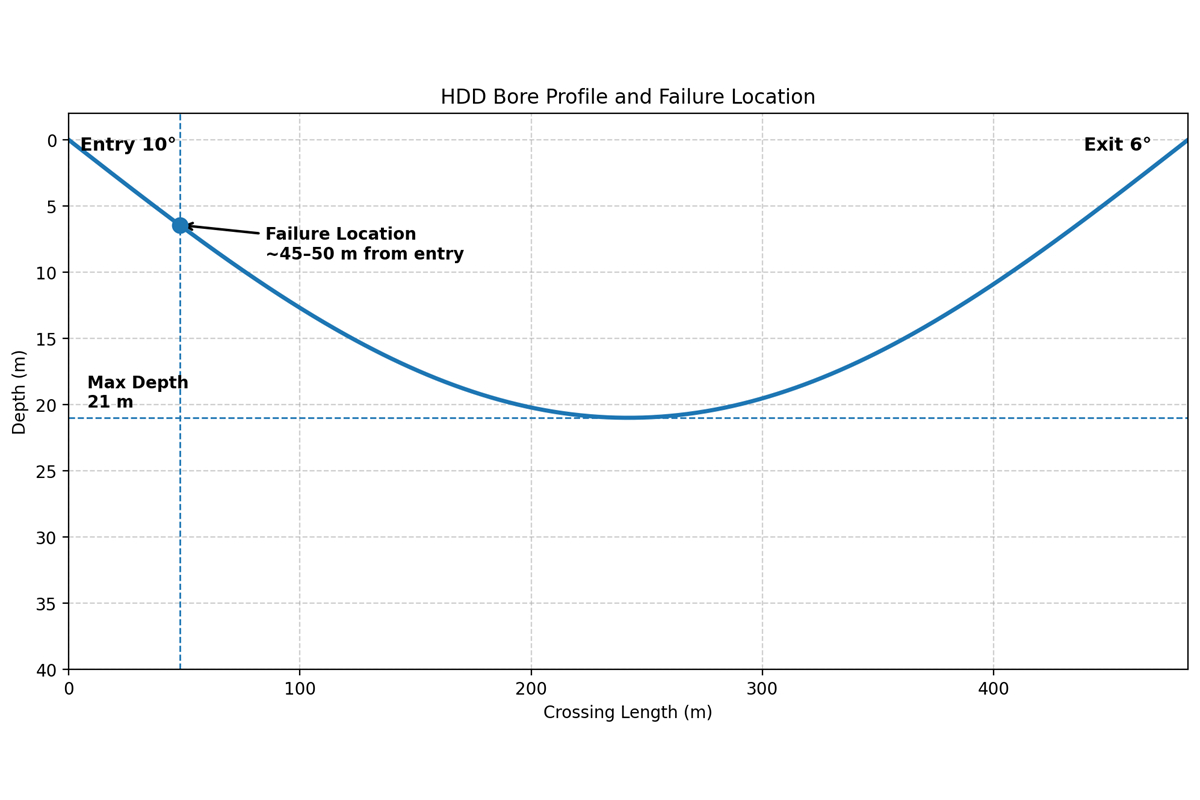
As noted, the bore geometry featured entry and exit angles of 10 and 6 degrees, respectively, with a 1,220 m radius of curvature.
This generous bend radius further confirms that curvature-induced bending was not the primary driver of the failure. Instead, mechanical loading was dominated by torque transmission, pullback forces, annular drag, and resistance concentrated near the reamer assembly.
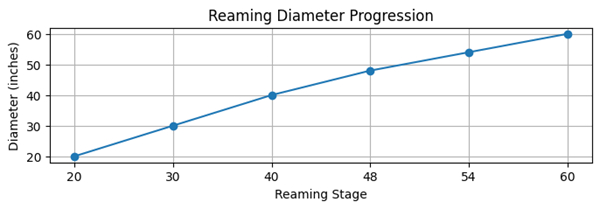
A progressive and gradual reaming sequence from 508 mm (20 in.) up to 1,524 mm (60 in.) borehole was employed to manage mechanical and hydraulic demands.
This staged enlargement procedure was designed to mitigate sudden spikes in mechanical loading and condition the bore prior to final pullback. However, the final 1,524 mm (60 in.) reaming stage imposed substantially higher mechanical and hydraulic demands due to:
- Increased cuttings volume and cuttings diameter,
- Expanded tooling-to-formation contact area,
- Elevated annular friction and drag resistance.
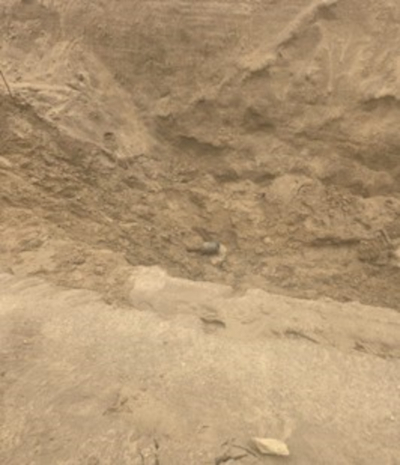
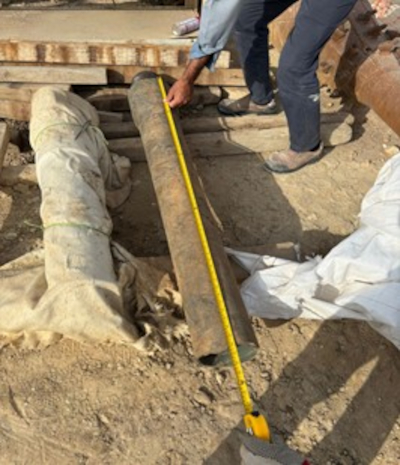
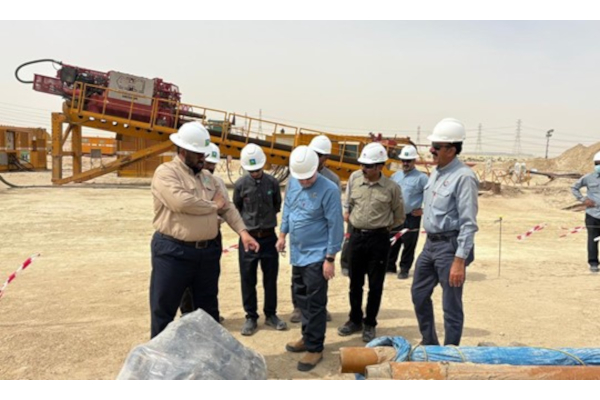
Figure 1 shows excavation activities performed to recover the fractured drill rod and retrieve the reamer while assessing the surrounding bore conditions following the final 1,524 mm (60 in.) reaming failure. Figures 2 and 3 show the field measurement and physical assessment of the fractured drill rod.
The fluid program maintained a viscosity of approximately 50 to 55 seconds and circulation rates of 650 to 900 L/min.
Continuous drilling returns were reportedly observed throughout the operation. However, surface returns alone do not necessarily guarantee effective cuttings transport during enlarged-bore HDD operations (Wilson and Driscoll 2017).
Inadequate hydraulic efficiency in this regime can lead to cuttings bed formation, localized pressure spikes, and elevated resistance near the bottom hole assembly.
The geotechnical profile consisted primarily of fill material, silty sand, and sandy fill zones. These materials may contribute to unstable cuttings transport behavior, localized accumulation, and increased annular resistance near the reamer.
Methods and Data Sources
This study employs a systematic investigation framework aligned with established failure analysis best practices, focusing on the identification of dominant failure mechanisms and the interactions between mechanical loads, bore conditions, and equipment performance.
The investigation follows a structured logical process, beginning with comprehensive problem definition and data gathering, followed by detailed causal factor analysis.
The analysis is grounded in the following data sources and investigative steps:
- Physical Evidence Examination: A thorough visual inspection of the failed drill rod and associated components was conducted to identify signs of mechanical distress, including fatigue cracks, plastic deformation, and corrosion, consistent with standard failure examination protocols.
- Operational Data Review: Performance indicators recorded during the event were analyzed to correlate operational parameters with the timing and progression of the failure.
- System Configuration Review: The HDD assembly layout and equipment specifications were evaluated to verify mechanical integrity and confirm tool suitability for the operational requirements.
- Geotechnical and Environmental Assessment: Bore alignment conditions, including soil composition and potential subsurface obstacles, were reviewed to contextualize external constraints influencing drilling dynamics.
- Stakeholder Consultation: Technical discussions with HDD contractors and operators supplemented automated monitoring data, capturing operational insights and contextual observations critical to the investigation.
By integrating physical evidence, operational telemetry, and field expertise, this qualitative approach ensures a holistic assessment of the failure event, supporting robust root cause determination and the development of targeted corrective actions.
Operational Data Analysis
Drilling logs were reviewed to track mechanical loading behavior during the final reaming stage.
The data reveals three distinct operational phases:
- Stable reaming phase,
- Progressive resistance development phase, and
- Overload phase immediately preceding failure.
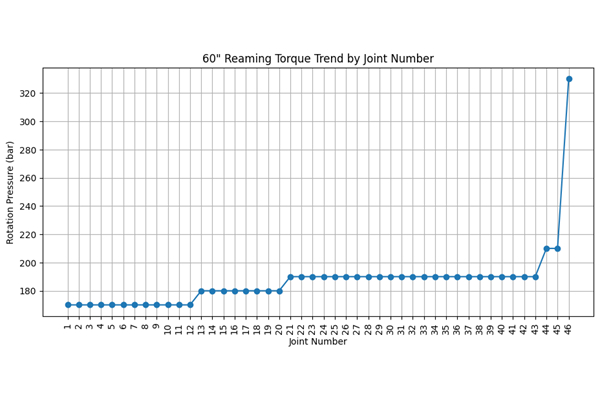
Torque indicators remained within expected operating ranges during the initial portion of the final reaming stage. A significant escalation in field torque was recorded at joints 45 and 46, directly preceding the drill rod fracture.
During the early stage of final reaming:
- Drill advancement rates remained consistent,
- Field torque indicators stayed within normal operating limits, and
- Drilling fluid circulation parameters showed minimal fluctuation.
This behavior indicates that the bore was adequately conditioned, annular resistance remained within manageable limits, and cuttings transport was initially effective. Conditions deteriorated significantly near joint 45.
Field data recorded:
- A substantial increase in torque,
- A marked reduction in advancement rate, and
- Approximately two hours required to complete Joint 45.
These indicators point to localized bore restrictions and elevated annular drag near the reamer assembly.
Contributing mechanisms likely include:
- Increased cuttings accumulation and bed formation,
- Reduced annular transport efficiency,
- Partial pack-off conditions, and
- Localized bore instability.
Despite maintained surface returns, the enlarged bore diameter significantly increased the hydraulic carrying requirement. The final reaming stage likely generated cuttings volumes that exceeded the localized transport capacity of the drilling fluid system.
At joint 46, field torque indicators escalated further under sustained loading conditions before the drill rod failed. The distinct torque spike immediately preceding failure is characteristic of an HDD overload condition driven by elevated bore resistance.
Continued operation under these conditions likely amplified:
- Torsional stress,
- Axial drag loading, and
- Combined stress concentrations near the reamer assembly.
Concurrent reductions in drilling fluid flow rates near the failure zone further impaired hydraulic transport efficiency, exacerbating annular resistance and accelerating mechanical fatigue.
Large-diameter HDD reaming generates substantially higher cuttings volumes than smaller stages. As bore diameter increases, annular cross-sectional area, cuttings generation, and hydraulic transport demand rise non-linearly. While surface returns remained visible, hydraulic efficiency near the bottom hole assembly may have been insufficient to maintain effective cuttings suspension and transport.
Localized cuttings accumulation can trigger:
- Elevated annular drag and friction,
- Unstable fluid circulation and pressure fluctuations,
- Impaired torque transmission, and
- Increased resistance to reamer advancement.
These effects are most pronounced near the reamer, where cuttings concentration and mechanical loading are highest, ultimately compromising drill string integrity.
HDD System Configuration
The HDD assembly during last reaming operation consists of the HDD rig, drill string or rod, 1,524 mm (60 in.) reamer and the drill string or rod.
The drill string transmits axial force, rotational torque and bending loads to the reamer assembly. The reamer enlarges the borehole and generate significant cuttings volume, requiring continuous circulation and efficient cuttings transport to maintain stable operational conditions.
During the final large-diameter reaming stage, elevated annular resistance, unstable bore conditions, and excessive torque fluctuations increased the mechanical loading within the drill string. These combined loading conditions resulted in progressive fatigue accumulation and ultimately caused fracture of the drill rod approximately 1.43 m behind the reamer assembly during the 1,524 mm (60 in.) reaming operation.
Figure 4 shows the staged reaming sequence adopted during the HDD operation. The final enlargement stages significantly increased cuttings volume and mechanical demand on the drill string.
Failure Description
The failure occurred during the final reaming stage during 1,524 mm (60 in.) at joint 46. The drill rod fractured approximately 1.43 m behind the reamer assembly, which represents the highest stress concentration location within the system. Macroscopic examination revealed a circumferential fracture with irregular and rough morphology. The fracture showed localized crack initiation, progressive propagation, and final overload rupture.
Operational observations indicated:
- Increasing resistance during reaming
- Extended duration for advancement (approximately 2 hours for joint 45)
- Further increase in torque during Joint 46, with continued operation
The failure location corresponds to the highest stress region in the drill string.
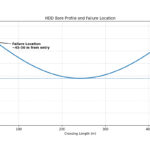
Figure 5 illustrates the HDD bore geometry and the approximate location of the drill rod failure relative to the reamer assembly. The failure occurred within the region of highest combined mechanical loading near the final reaming section.
Mechanical Analysis
The drill rod was subjected to combined axial, torsional, and localized bending stresses during the final 1,524 mm (60 in.) reaming. Elevated annular resistance and increased drag forces generated abnormal rotational loading near the reamer assembly.
Progressive fatigue degradation reduced the residual load carrying capacity of the drill rod, making it susceptible to sudden overload fracture under sustained operation loading conditions.
Figure 6 presents the operational torque trend during the final reaming stage. A distinct escalation in torque was observed immediately prior to failure, indicating a localized increase in bore resistance and overload conditions.
Hydraulic and Bore Interaction
Large-diameter reaming increases cuttings volume significantly. Insufficient flow results in cuttings accumulation, increased friction, and elevated resistance. Soil conditions such as silty and soft sand further contribute to bore instability. Elevation differences cause uneven fluid behavior, increasing localized resistance near the reamer.
Integrated Failure Mechanism
The failure sequence involves reamer dragging upward towards the rig, increased resistance, load transfer into the drill string, and failure at the highest stress concentration point. This represents a combined mechanical and geotechnical failure mechanism.
Figure 7 summarizes the sequence of operational events leading to failure, beginning with stable drilling conditions and progressing through increasing torque, reduced advancement, elevated resistance, and final overload fracture.
Root Cause Analysis and Contributing Factors
The primary root cause of the failure was overload of a fatigue-weakened drill rod caused by elevated annular resistance during final 1524 mm (60 in) reaming. Key contributing factors include bore and soil conditions, poor hole cleaning, elevation effects, fatigue, and continued operation under abnormal load conditions.
Bore and Soil Conditions
The presence of silty and soft sand contributed to cuttings accumulation and increased localized resistance.
Hole Cleaning Efficiency
Insufficient hole cleaning during large-diameter reaming resulted in reduced cuttings transport and increased drag.
Elevation Profile
The crossing profile required reaming in an uphill direction, influencing drilling fluid behavior and resulting in uneven cuttings transport and reduced support near the reamer.
Fatigue
Repeated cyclic loading reduced the residual strength of the drill rods, making them more susceptible to failure under overload conditions.
Industry Observations
Industry discussions indicate recurring challenges affecting HDD operations:
- Equipment maintenance variability
- Operator competency differences
- Planning and design limitations
- Operational constraints
- Quality assurance/control inconsistencies
These observations suggest that such failures are not isolated events but reflect broader systemic challenges.
Implications for Practice
This case demonstrates that large-diameter HDD drill string failures are rarely attributable to a single isolated factor. Instead, they arise from the interaction between drill string mechanical integrity, borehole hydraulic performance, operational decisions, and subsurface conditions.
- Improve hole cleaning performance and verify cuttings transport effectiveness.
- Monitor rotational pressure, drag, advancement rate, and circulation trends continuously.
- Define and enforce operational stop criteria for abnormal rotational pressure escalation.
- Enhance drill rod inspection and maintenance practices.
- Conduct conditioning and cleaning passes during large-diameter reaming.
- Standardize QA/QC procedures for drill string components and reaming operations.
Preventive Measures
To mitigate similar risks and reduce the likelihood of future drill string failures, the following measures are recommended:
Integrated Hydraulic Management
Drilling fluid viscosity, flow rate, and pump pressure should be continuously optimized to maintain efficient cuttings transport throughout all reaming stages.
Real-Time Operational Monitoring
Rotational pressure, drag, penetration rate, advancement time, and circulation performance should be tracked continuously to identify abnormal loading trends before escalation.
Drill String Integrity Control
Pre-job verification, routine inspection protocols, fatigue tracking, and load-limit compliance should be enforced for all drill rods and directional drilling components.
Borehole Cleaning Practices
Periodic conditioning and dedicated cleaning passes should be conducted during large-diameter reaming to minimize cuttings accumulation and annular obstruction.
Disciplined Operational Decision-Making
Clear operational thresholds should be established for rotational pressure and drag escalation, with mandatory pauses for evaluation whenever abnormal loading conditions are detected.
Study Limitations
The analysis presented in this paper is based primarily on field observations, operational drilling records, and macroscopic fracture interpretation. Detailed metallurgical examination and laboratory fractography were not available during preparation of this investigation. Therefore, the fatigue interpretation is based on fracture morphology and operational evidence rather than laboratory-confirmed microscopic fractography.
Conclusion
The drill rod fracture during final 1,524 mm (60 in.) reaming for installation of a 1,016 mm (40 in.) product pipeline resulted from the combined effects of fatigue degradation and mechanical overload. The failure occurred approximately 1.43 m behind the reamer toward the rig side, where stress concentration and repeated cyclic loading created a critical weak point within the drill string.
Operational drilling logs corroborate this mechanism. Rotational pressure indicators remained relatively stable through joint 44, followed by sharp escalation at joints 45 and 46 immediately preceding the fracture. This sudden increase validates the onset of abnormal loading conditions associated with elevated bore resistance and increasing drag forces.
The investigation confirms that continuous drilling returns observed at surface did not necessarily guarantee effective downhole cuttings transport. In enlarged boreholes, insufficient hydraulic efficiency can result in localized cuttings accumulation, unstable circulation, elevated annular drag, and nonuniform load distribution, even when surface indicators initially appear acceptable.
Effective large-diameter HDD reaming operations require synchronized management of equipment performance, borehole hydraulics, and field execution practices. By proactively addressing both mechanical and hydraulic limitations, operators can significantly reduce the risk of premature drill string failure and improve the overall success of future HDD crossings.
Awadh O. Al-Oadah, PhD, is director of projects in the Pipeline Projects Department at Saudi Aramco. Misfer S. Al-Zahrani, BSE, is a project engineer in the Pipeline Projects Department at Saudi Aramco.
REFERENCES
API 2020. “Specification for Drill Pipe (API Specification 5DP).” American Petroleum Institute.
Bennett et al. 2024. “Horizontal Directional Drilling: Good Practices Guidelines.” North American Society for Trenchless Technology (NASTT).
Ma 2004. “Fatigue of Drill Pipes Used in Horizontal Directional Drilling.” Doctoral Dissertation, Louisiana Tech University.
Najafi 2018. “Trenchless Technology: Planning, Equipment, and Methods.” McGraw-Hill Professional.
Willoughby 2005. “Horizontal Directional Drilling: Utility and Pipeline Applications.” McGraw-Hill Companies.
Latest Posts
- Failure Analysis of Drill Rod Fracture During Large-Diameter HDD Pipeline Reaming
- No-Dig North 2026 Preview – Heading to Calgary

- Contractor Profile – SKE Construction
- NASSCO Report – Florida City Rehabilitates More Than 1,600 Manholes
- PG&E Files 10-Year Electrical Undergrounding Plan

Next Up
HDD Rodeo | December 2-4, 2026 | Perry, Georgia | Learn more
HDD Academy | February 18-19, 2027 | Scottsdale, Arizona | Learn more
Microtunneling Short Course | May 4-6, 2027 | Scottsdale, Arizona | Learn more
Water Finance Conference | August 3-4, 2027 | Cleveland, Ohio | Learn more