How Early Earth-Boring Tools Evolved into Today’s HDD Systems
Long before horizontal directional drilling (HDD) became a defined construction discipline, early earth-boring crews were solving practical installation problems with compact cutting tools, pneumatic motors, water and mechanical alignment.
The technology did not emerge from a single breakthrough. It developed incrementally as contractors, utilities and toolmakers responded to clay, roots, longer pipe runs, difficult ground and the need for greater control underground.
The Fish-Tail Bit Era
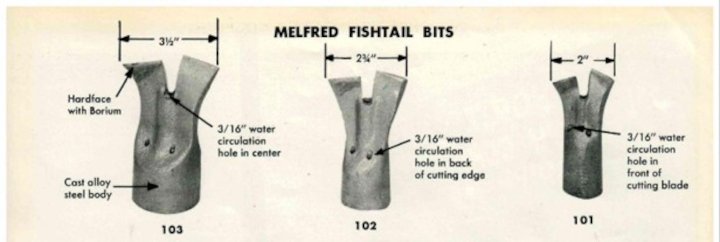
The story began in 1946, when Fred Melsheimer left Baker Oil Tool, a manufacturer of cutting tools for drilling oil wells, and adapted the familiar fish-tail bit for small-diameter horizontal earth boring. The design was scaled down and modified for utility work. Three initial bit sizes were produced, with the primary version cutting a 2-in. hole and using a 7/8-in. 9 NC connection. The bits were hard-faced and incorporated a central water passage.
Larger versions were also made to thread directly onto 1 1/2-in. and 2-in. electrical conduit. In these installations, the conduit itself served as the drill rod. Contractors bored beneath a roadway, removed the cutting bit at the exit, and left the conduit in place. The method was direct, economical, and well-suited to street-lighting work.
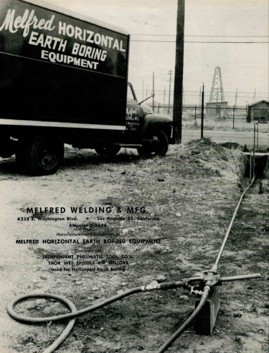
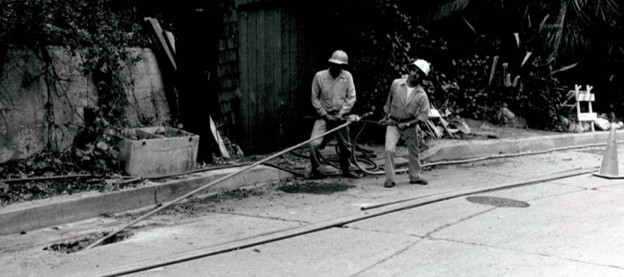
These early bores were not electronically steered. Crews worked from pothole to pothole, often at intervals of about 50 feet. At each opening, they exposed the drill head, checked alignment and mechanically redirected the string with hand tools before continuing. The tooling was designed first to cut and remain on line, not to steer in the modern sense.
First Earth Boring Machines
The power units evolved alongside the cutting tools. Early systems often relied on handheld pneumatic motors of roughly three horsepower. Water entered through the rear of the motor and continued through a swivel and drill rod to the bit. The motor supplied rotation, while two workers physically pushed the assembly to create thrust. Drill rods were commonly available in 10- or 20-ft lengths.
Experience also revealed the importance of rotational speed. Small pilot holes tended to track more accurately when the bit rotated quickly enough to cut cleanly instead of carving and washing out an oversized path. The purpose-built DynaMole rig was designed to operate near 350 rpm. Some later machines placed greater emphasis on torque and operated closer to 70 to 100 rpm, illustrating an early design debate that would continue as drilling equipment matured.
Fluid practices were equally basic. Some work was completed dry, while other bores used only water. In clay, crews sometimes added dishwashing soap as a rudimentary lubricant. As bore lengths increased, fluid management became more important. Bentonite and other additives allowed crews to adjust viscosity, carry cuttings through the bore, support the hole and manage pressure and pullback force. Poor cuttings transport could increase downhole pressure and pullback loads, with resulting risks to the product pipe and the installation.
PE Changes Everything
The growing availability of polyethylene (PE) gas pipe altered the practical limits of earth boring. Steel gas lines required welded joints and extensive trench access. Polyethylene pipe could be supplied in continuous reels of 1,000 or 2,000 ft, making longer trenchless installations increasingly attractive.
Longer bores exposed new tooling problems. In the sticky clay common around Pasadena, California, small water passages in fish-tail bits could plug before adequate flow reached the cutting face.
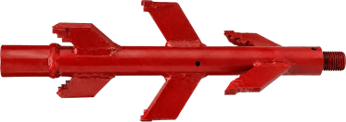
The response was during the early 1960s, Dick Melsheimer and his brother began working closely with the Southern California Gas Company to redesign a bit with the outlet relocated into the eye and enlarged from approximately 3/16 in. to about 7/16 in. The larger, protected opening allowed water to discharge more freely and made plugging far less likely.
New Problem, New Tool
At the time, earth-boring tooling was not yet a mature manufacturing category. Specialized suppliers were few, and field-made bits, couplings and modified components were common. Tool development depended heavily on direct observation. Crews reported where water ports plugged, where blades balled with clay and where cutting edges failed. Designs were then altered, the bit was modified and returned to the field.
That proximity to the jobsite mattered. Many of the features now treated as standard in HDD tooling were not conceived as broad product strategies. They were practical responses to a specific ground condition, installation method or equipment limitation.
Reamer Evolution
Reamers initially addressed accuracy as much as finished hole diameter. Without electronic steering, crews wanted the pilot bore to remain small because a closely confined drill string was less able to wander. After completing the pilot, they pulled a reamer back through the bore to enlarge it for the product pipe.
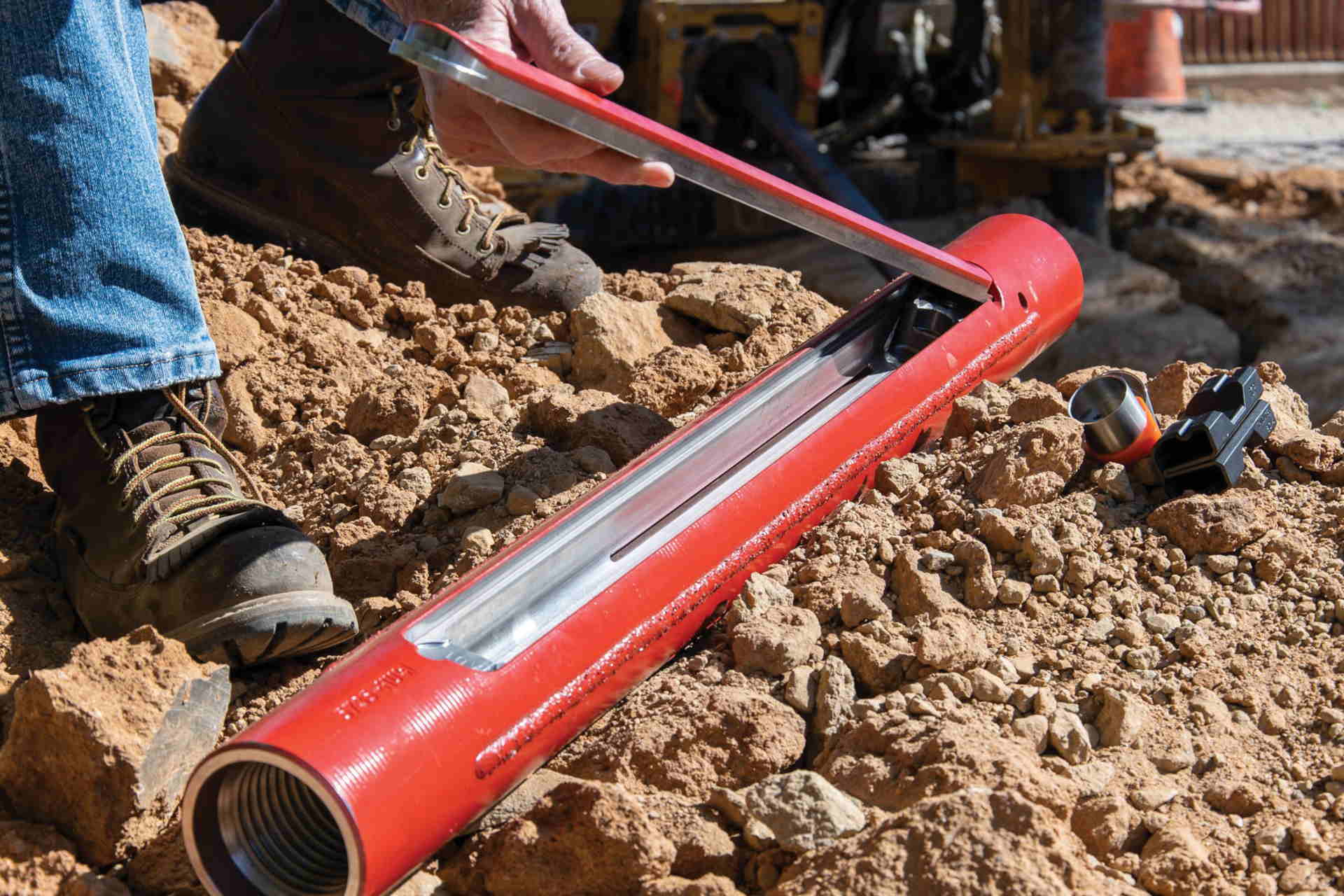
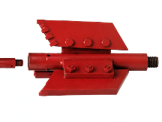
One early approach used a reusable reamer body with replaceable blades. The blades were forged with a trip hammer, ground, hard-faced or fitted with carbide, and bolted onto a common body in different sizes. The concept reduced the number of complete tools required, but the exposed bolts and closely spaced components created problems in sticky formations.
Clay could accumulate around the fasteners until the reamer became a large, ineffective ball of mud. Later designs simplified the blade arrangement and promoted mixing and clearing. The Chopper reamer, developed after Dick Melsheimer established Borzall Tools in 1981, initially used three blades. Field experience showed that the spacing was too tight and encouraged clay packing. A two-blade configuration cleared more effectively in clay, while four-blade arrangements were better suited to rockier ground.
Electronics & HDD
The meaning of directional drilling changed when underground locating electronics began to supplement mechanical alignment. Early pipe-locating manufacturers developed compact transmitters capable of being detected at depths of roughly 20 ft. These systems were rudimentary. Operators interpreted audible signals and used the transmitter orientation to estimate the position of the drill head.
To put a transmitter downhole, early builders fabricated simple housings for an approximately 8-in. sonde. A flat piece of 2-in. steel could be welded to the front at an angle. By rotating the drill string to a chosen clock position and pushing without rotation, the angled face redirected the head. The arrangement was crude by current standards, but the basic principle – orientation plus asymmetric cutting geometry – remains central to modern walkover-guided HDD.
By the early 1990s, directional drilling machines were also adopting combined hydraulic and electronic controls. The Sure Shot machine used a control station with joystick operation for forward thrust and drill-string rotation. Beginning in 1991, field demonstrations introduced utilities and contractors not only to a machine, but to the broader idea of installing underground infrastructure with less surface disruption.
The machine market soon expanded as larger manufacturers introduced more powerful, tractor-mounted rigs. Smaller developers often lacked the manufacturing capacity to compete at that scale and returned their attention to tooling. Even so, control concepts developed during this period – including joystick management of thrust and rotation – became familiar elements of modern HDD equipment. The Sure Shot represented the transition from mechanically aligned earth boring toward electronically-assisted HDD equipment.
Before the Industry Had a Name
By the early 1980s, more companies had begun producing drill rod, bits and related components, and the loose collection of earth-boring practices was beginning to resemble a distinct industry. Yet participants at the time were usually focused on the immediate work: getting through the soil, keeping a bore open, controlling the head and installing pipe without damage.
Dick Melsheimer recalls that the significance of those incremental advances was not obvious at the time. “The engineers and crews involved were solving one problem after another,” he said.
During demonstrations of the Sure Shot, however, he came to believe that HDD rigs would eventually become as common on utility jobsites as backhoes.
The prediction proved sound. Modern HDD equipment is far more powerful, precise and instrumented than the early air motors, fish-tail bits and audible sondes. Still, much of its underlying logic can be traced to those first practical lessons: keep the pilot bore controlled, move the cuttings, protect the hole, match the cutter to the ground and let jobsite problems drive the next design.
Josh Parker is director of marketing and ecommerce at Melfred Borzall.
Latest Posts
- PG&E Files 10-Year Electrical Undergrounding Plan

- HDD Contractor Faces Tough Rock Drilling Under the Illinois River
- Vortex Companies Expands its UK Footprint

- Sprayable Linings Used in Municipal Sewer Manhole Rehabilitation
- AEM Manufacturing Express Celebrates American Augers Workforce in Ohio
Next Up
HDD Rodeo | December 2-4, 2026 | Perry, Georgia | Learn more
HDD Academy | February 18-19, 2027 | Scottsdale, Arizona | Learn more
Microtunneling Short Course | May 4-6, 2027 | Scottsdale, Arizona | Learn more
Water Finance Conference | August 3-4, 2027 | Cleveland, Ohio | Learn more