NASSCO Report – Rehabbing Force Mains Through Multiple Bends Using FFRP in Metro Atlanta
Aging pressure pipes installed across the nation are reaching the end of their useful life, requiring utilities to find timely and cost-effective upgrade solutions. Fulton County Department of Public Works is taking a proactive approach to this challenge, identifying the Sullivan Basin as a strong rehabilitation candidate with four force mains in need of upgrades.
Fulton County partnered with Azuria-Underground Solutions to evaluate a wide array of solutions assessing four 14- to 16-in. Ductile Iron Pipe force mains (<1030 LF each) installed in the late 1970s within a high-end residential neighborhood.
Even though condition assessments are often the first step in the process, pressure pipe inspections can present unique challenges. Unlike gravity sewer systems, which can be readily assessed through existing manhole access, force main assessment tools often require specialized infrastructure such as pig launching stations, adding cost and complexity to the front-end evaluation process not applicable for these short force main sections.
In Fulton County’s case, the combination of pipe material, age, short lengths, and operational history led to a decision to skip the condition assessment phase and move ahead to replacement/rehabilitation of all four force mains.
Evaluating Options & FFRP Technology
There is no silver bullet solution for rehabilitating pressure pipelines. A range of parameters must be carefully weighed, including internal pressures, external loads, pipe diameter, number of bends, service connections, valve locations, host pipe structural integrity, access constraints, repair types, total length, timing, and bypass requirements.
In this case, cured-in-place pipe (CIPP), horizontal directional drilling, conventional slipline, and pipe bursting all presented challenges due to significant elevation changes, cost, tight constraints and the amount of bends throughout the pipelines.
Open cut and flexible fabric reinforced pipe (FFRP) emerged as the two most viable options, and a hybrid approach was developed to address the force mains based on their unique conditions. Primus Line FFRP liner is a Class 3, ASTM F3708 compliant liner that consists of an outer layer of abrasion-resistant polyethylene (PE), an inner PE layer, and an internal woven aramid fabric. Following extrusion, the liner is cured, folded into a C-shape, taped, and then delivered to the job site on a reel cut to the required length.
For force main applications, it is critical to confirm there are no free inlets or outlets and that the pipe remains on a positive gradient, always filled or under pressure. Check valves are required on the low end, and manhole modifications may be necessary at the top end.
General contractor Sol Construction handled open cut work and bypass operations, while trenchless contractor Gulf Coast Underground performed the FFRP installation. Of the four force mains, two were replaced entirely via direct bury, one utilized FFRP lining pump station to manhole, and the fourth is employing a hybrid of direct bury and FFRP for a 16-in. DIP force main.
Field Execution & Site Installation
Sullivan Force Main #1 presented complex conditions — 810 lf routed through a high-end residential neighborhood with a 90-ft change in elevation and three horizontal bends ranging from 22.5 to 45 degrees. Sol Construction installed a temporary bypass and excavated access pits at the manhole and just outside the pump station. Gulf Coast Underground then completed CCTV inspection and cleaning of the host pipe prior to liner installation.
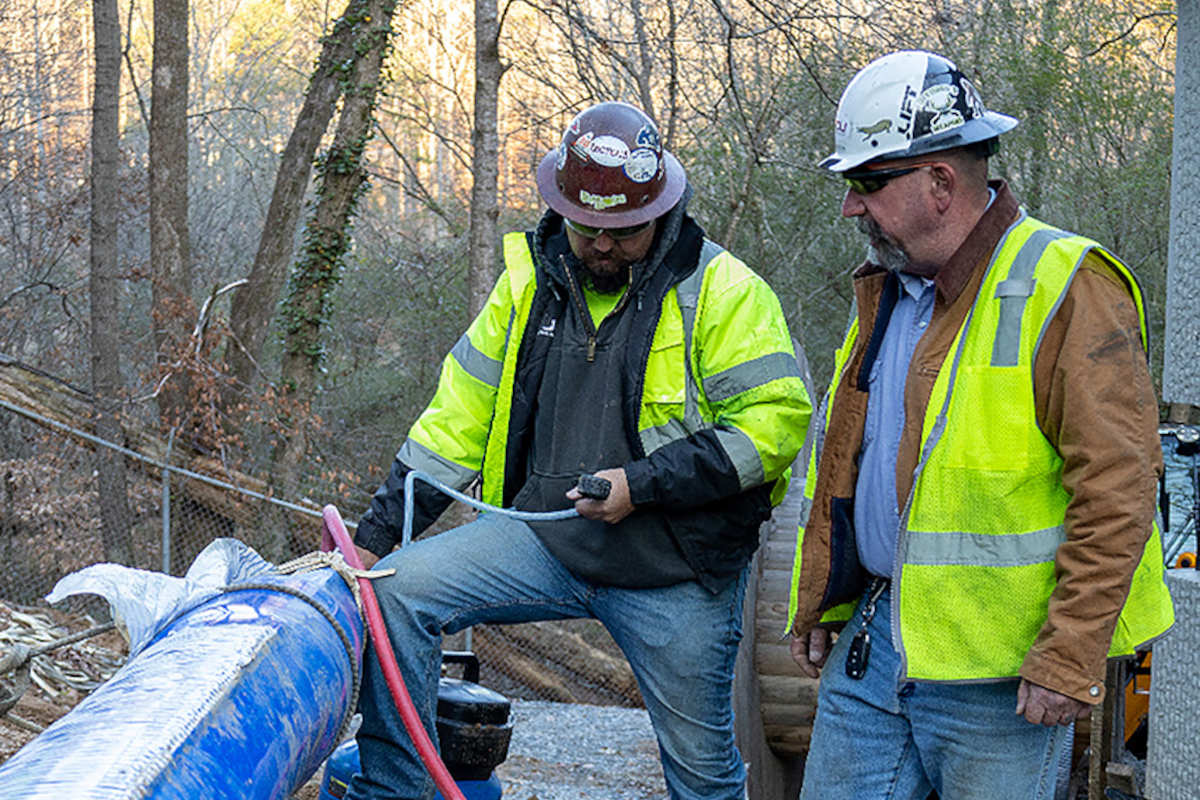
Mule tape was pulled through using the CCTV robot, followed by a cable connected to a constant-tension winch. The FFRP liner was positioned with a forklift, connected to the winch cable and sliplined into place in under one hour. Test plugs were then inserted into the liner ends and a heavy-duty air compressor pressurized the liner to approximately 15 PSI to break the tape.
After cutting the liner to final length, Primus ANSI #150 fittings were installed leaving flanged connections. Sol Construction completed the work by connecting the force main to the pump station and manhole with a short direct-bury sections. A similar approach was implemented for Sullivan Force Main #2, consisting of 650 lf of FFRP rehabilitation of the existing 16-in. ductile iron force main, along with 350lf of open-cut replacement.
The Sullivan Basin project demonstrates that a flexible, hybrid approach is often the most practical path forward for aging force main infrastructure. By combining direct bury and FFRP lining, Fulton County was able to tailor solutions to each pipeline’s specific conditions — minimizing disruption in a sensitive residential corridor while delivering a durable, long-term rehabilitation solution.
The project serves as a replicable model for utilities facing similar mid-century infrastructure challenges nationwide.
Latest Posts
- Contractor Profile – SKE Construction
- 2026 Trenchless Rail Crossings Special Report
- NASSCO Report – Florida City Rehabilitates More Than 1,600 Manholes
- PG&E Files 10-Year Electrical Undergrounding Plan

- HDD Contractor Faces Tough Rock Drilling Under the Illinois River
Next Up
HDD Rodeo | December 2-4, 2026 | Perry, Georgia | Learn more
HDD Academy | February 18-19, 2027 | Scottsdale, Arizona | Learn more
Microtunneling Short Course | May 4-6, 2027 | Scottsdale, Arizona | Learn more
Water Finance Conference | August 3-4, 2027 | Cleveland, Ohio | Learn more