NASSCO Report: What Goes Down Must Build Up
One of the more interesting findings from the 2023 Test Cell Grouting Research White Paper by NASSCO’s Grouting Committee was not necessarily that grout migrated beneath the pipe first, but that the research visually validated what experienced grouting professionals have observed in the field for decades.
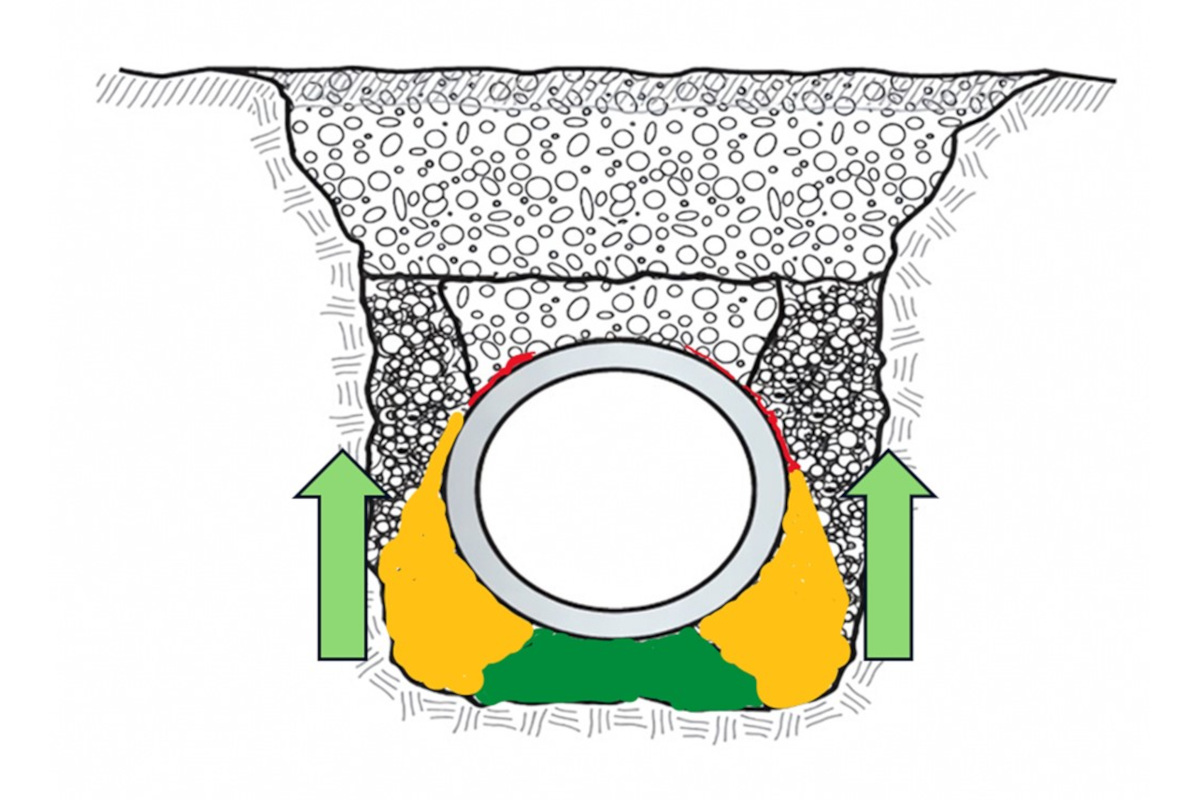
Injection grout naturally follows the path of least resistance and is influenced by gravity. This bottom-up migration creates a continuous grout envelope. It seals infiltration pathways but also fills surrounding voids, improves soil support, and helps stabilize the pipeline.
In the test cells, grout exiting the defect consistently migrated beneath the pipe, filled surrounding voids, contacted the trench base, then progressively built upward around the pipe structure. As gel times increased, the grout traveled farther. This forms a larger grout masses and ultimately creating a more substantial cradle beneath the pipe. Although the research focused on packer injection grouting of mainline pipes, the concept should sound very familiar to anyone involved with curtain grouting applications.
Parallels in Curtain Grouting Applications
A similar grout migration pattern is routinely observed during curtain grouting applications. Lower injection points frequently consume significantly greater grout volumes than points injected at higher elevations. While this can sometimes create concern during injection because it can appear that grout is being “lost” into the substrate, it is more often an indication that the grout mass is developing as intended. The lower injection points are building the foundation that later injections depend upon. This is particularly evident when using expansive grouts.
As grout migrates downward, it fills voids, permeates open pathways, and begins establishing a base of material beneath the structure. Once the initial grout foundation develops, subsequent injections are less likely to migrate away from the grout zone. Instead it begins building back toward the structure itself. This explains why the lowest row of injection points in a curtain grouting application typically requires more grout than the rows above. In effect, the grout is creating its own containment boundary. This allows each successive injection to expand and consolidate the grout curtain more efficiently.
Controlled Buildup via Stage Grouting
This same behavior also helps explain why stage grouting is often highly effective when using injection grouts. Consider a grout with an approximate polymerization (cure) time of 45 seconds. Rather than continuously pumping large volumes of material, grout is injected in a series of controlled stages. An initial small amount of grout is injected and allowed to react and begin polymerizing. After approximately 45 seconds, a second controlled injection is made, followed by another waiting period. By the third stage, an initial grout mass has often been established.
The previously formed grout mass becomes increasingly important because it begins functioning as a barrier. Rather than allowing newly injected grout to continue migrating into surrounding soils, cracks, or bedding materials, the material begins accumulating adjacent to the structure where the seal is required.
Viewed another way, stage grouting is far more than simply pausing between injections.
It is a deliberate technique that utilizes the grout’s reaction characteristics to progressively develop a larger and more effective containment zone. The process transitions from unconstrained grout migration to controlled grout mass buildup at the point of repair, resulting in a more effective seal, improved grout utilization, and reduced material waste.
Visual Validation for Field Operations
The NASSCO Test Cell Research White Paper, which is available for free download at nassco.org/resources, provides valuable visual validation of grouting principles and concepts many grouting professionals have long understood through experience and field observation. Whether sealing pipe defects or curtain grouting behind or beneath structures, the objective extends far beyond simply filling a void.
Successful injection grouting requires an understanding of how grout migrates, how it develops into a supporting mass, and how its natural flow can be leverages to place material where it will generate long-term soil stabilization and groundwater control.
Charlie Lerman is with Avanti International and a member of the NASSCO Grouting Committee.
Latest Posts
- Contractor Profile – SKE Construction
- 2026 Trenchless Rail Crossings Special Report
- NASSCO Report – Florida City Rehabilitates More Than 1,600 Manholes
- PG&E Files 10-Year Electrical Undergrounding Plan

- HDD Contractor Faces Tough Rock Drilling Under the Illinois River

Next Up
HDD Rodeo | December 2-4, 2026 | Perry, Georgia | Learn more
HDD Academy | February 18-19, 2027 | Scottsdale, Arizona | Learn more
Microtunneling Short Course | May 4-6, 2027 | Scottsdale, Arizona | Learn more
Water Finance Conference | August 3-4, 2027 | Cleveland, Ohio | Learn more