Fact vs. Fiction: Misconceptions of Injection Grouting
Injection grouting is one of the original trenchless rehabilitation technologies. Its roots trace back to the 1950s, when acrylamide grout was first used for soil stabilization in dam cutoff applications.
In the trenchless sewer industry, its modern history began in 1962, when the first sewer mainline was sealed using acrylamide grout. The success of that project established the foundation for today’s injection grouting practices in wastewater collection systems — all without disturbing the surface above.
Despite early success, the municipal injection grouting industry operated for decades with no performance standards or formalized operating guidelines. Prior to the early 2000s, standardized procedures, documentation requirements, and verification methods were minimal.
Contractors often relied on individual practices, with inconsistent logging and quality control. In some cases, inadequate application led to underperformance, reinforcing the misconception that injection grouting was merely a short-term fix.
Those outdated assumptions still persist in some corners of the industry — even as the technology, materials, testing standards, and engineering methodologies have significantly advanced.
Below are five common misconceptions about injection grouting — and the realities behind them:
1 – Injection grouts are only used for stopping leaks
The reality is that injection grouts like polyurethane and acrylic gel systems are frequently used for applications other than just stopping active or potential infiltration (I&I). Grouts are often utilized for permeation grouting in loose, granular soils, curtain grouting for structure stabilization, void filling, compaction and densification, and for groundwater cutoff barriers. While they are an excellent source of I&I elimination, their scope goes well beyond just that.
Injection grouting is not simply a reactive leak repair method. It also functions as a proactive ground improvement and groundwater control system.
2 – Injection grouts do not provide any strength or stability
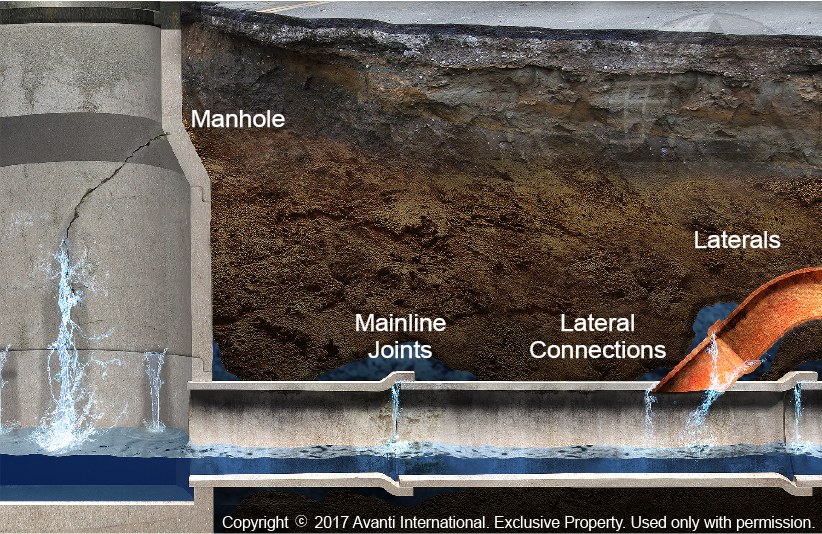
Properly selected injection grouts can increase soil strength, improve load-bearing capacity, and reduce settlement potential. Over time, injection grouting has evolved from a leak-sealing practice into a recognized soil stabilization method for underground infrastructure including sewer system assets such as manholes, laterals, and mainlines, vaults, tunnels, shafts, and mines.
To better understand grout behavior, the NASSCO Infiltration Control Grouting Committee conducted a full-scale grouting test cell study examining grout migration, mix concentrations, gel/soil formations, and gel-time influence. The resulting 52-page publication, The Test Cell Grouting Research White Paper, demonstrates that properly installed injection grout not only stops infiltration but also stabilizes the surrounding sewer trench.
The data reinforces what experienced engineers have observed in the field for decades: injection grouting is both a hydraulic and geotechnical solution. Download the white paper, at nassco.org/grouting.
3 – Injection grouts are not durable for the long-term
ng-term durability has been extensively studied. The U.S. Department of Energy (DOE) conducted a comprehensive evaluation of different grout formulations for reducing soil permeability around hazardous waste containment areas. After a 10-year evaluation of seven grout systems, acrylamide grout was selected for long-term encapsulation performance. In “In Situ Grouting of Buried Transuranic Waste” (1986), the undisturbed acrylamide chemical grout was determined to have an approximate half-life of 362 years.
Modern injection grouts are engineered to provide long-term hydrolytic stability, chemical resistance, freeze/thaw, wet/dry cycle durability, and designed for groundwater exposure.When properly designed and installed, injection grouting systems serve as permanent groundwater control and soil stabilization solutions in critical underground infrastructure worldwide.
4 – All injection grouts behave the same
Not all injection grouts are created equal. Injection grout is a broad category encompassing fundamentally different chemistries, reaction times, and performance outcomes. Material selection depends on groundwater conditions, soil type, structural movement, and project performance goals.
Major grout families include acrylamide, acrylic gels, hydrophilic polyurethanes, hydrophobic polyurethanes, Ultrafine cements, epoxies, and more. These materials vary significantly in viscosity, gel time, expansion behavior, flexibility versus rigidity, permeability reduction capability, and structural contribution. Treating them as interchangeable can result in underperformance or unintended consequences. Injection grouting is not always a one-grout solution — it is a material science and engineering decision. It is also important that the owner, engineer, contractor and manufacturer collaborate together for success in the field.
5 – Injection grouts are environmentally unsafe
Today, many injection grout materials undergo rigorous third-party water quality testing from associations such as Water Quality Association and achieve certification under NSF/ANSI/CAN 61 for Drinking Water System Components. This certification confirms that materials in contact with drinking water do not leach harmful levels of contaminants.
Once properly injected and cured according to manufacturer guidelines, most modern chemical grouts are inert, non-toxic, and irreversible. As with any engineered material, product selection should align with environmental requirements, regulatory standards, and site conditions. Check with injection grout manufacturers for their NSF/ANSI/CAN 61 certificates.
Conclusion
Misconceptions matter because injection grouting is rarely just a product-driven application. It is also an engineered process. Soil conditions, groundwater dynamics, structural movement, and long-term durability requirements dictate both material selection and injection strategy. When assumptions replace technical evaluation, projects risk costly callbacks, unnecessary rehabilitation cycles, or premature failure.
Decades of research and innovation, field validation, and evolving industry standards have demonstrated that injection grouting – when properly designed and executed – is a durable, long-term, and reliable rehabilitation and ground improvement technology.
Jessica Williams is director of marketing and communications at Avanti International.
Latest Posts
- Digital Bore Planning Drives Better HDD Decisions

- Trenchless Technology Canada – Association Updates Fall 2026

- Organizers Recap UESI Pipelines 2026 Successes, Look Forward to Louisville

- Rädlinger Primus Line Hosts Partner Days 2026

- MaxLiner Expanding U.S. Distribution Network

Next Up
HDD Rodeo | December 2-4, 2026 | Perry, Georgia | Learn more
HDD Academy | February 18-19, 2027 | Scottsdale, Arizona | Learn more
Microtunneling Short Course | May 4-6, 2027 | Scottsdale, Arizona | Learn more
Water Finance Conference | August 3-4, 2027 | Cleveland, Ohio | Learn more