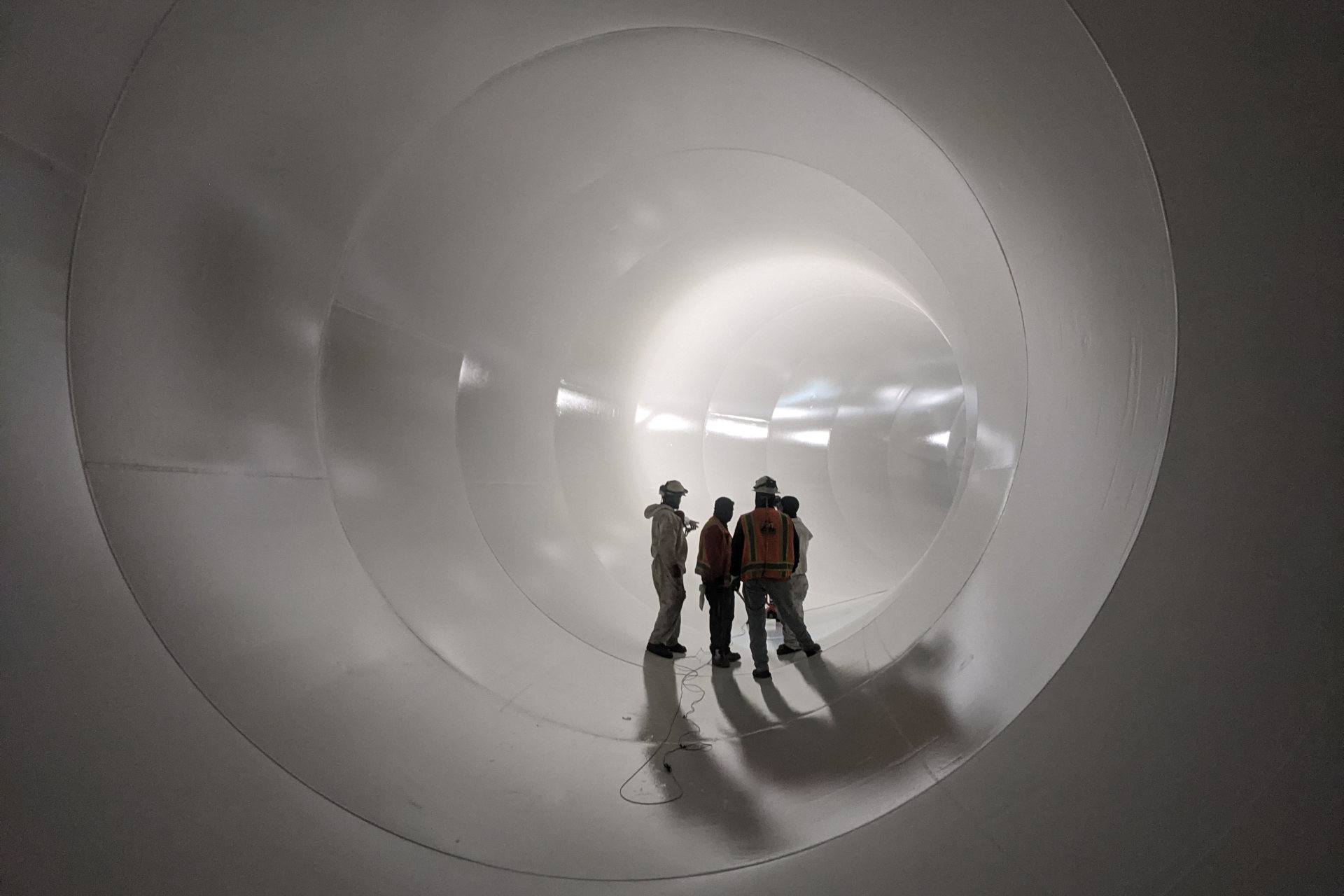
Relining Adds Second Life to Don Pedro Dam Penstock
Restoring the Don Pedro Dam penstock was a high-stakes infrastructure project with little margin for error.
Located roughly 300 ft below ground, the 16.5-ft diameter steel penstock carries water to the hydroelectric turbines that help generate carbon-free electricity for Northern California.
After roughly 50 years of service, the structure needed a full interior rehabilitation to protect it from corrosion and deterioration and to support another half century of reliable operation. The work gave the penstock a second lifetime and supported the long-term performance of a major public power asset.
The relining effort formed part of the Don Pedro Project’s broader Life Extension and Upgrade Program, which began in 2010. Owned by the Turlock and Modesto Irrigation Districts, the hydroelectric facility has undergone a series of mechanical and structural upgrades intended to return key components to like-new condition.
Restoring the penstock lining was especially important because the pipe is central to plant performance. It carries reservoir water through turbines that contribute to the plant’s 203-megawatt generating capacity. Ensuring this asset could perform for another 50 years was a critical objective.
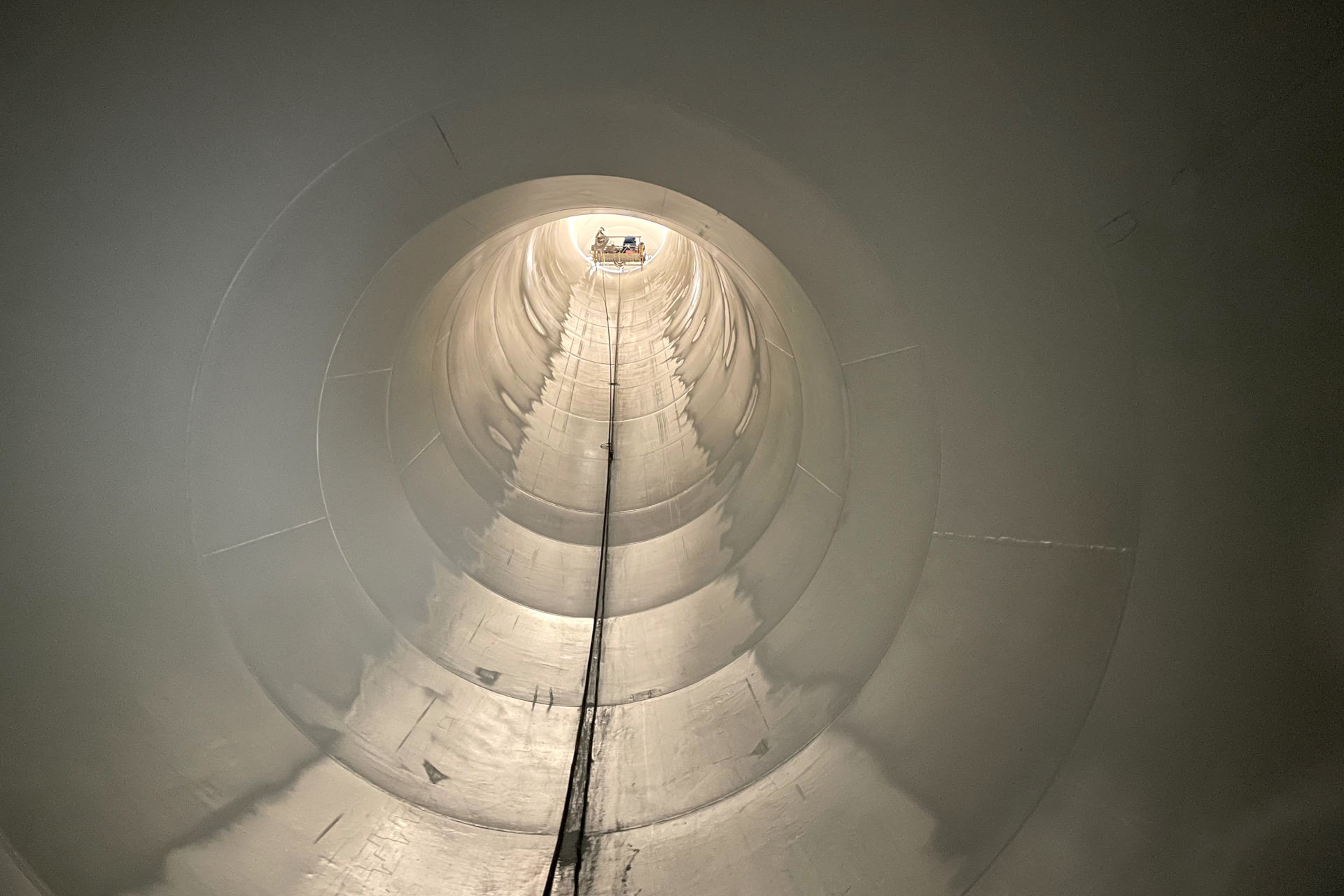
via pulleys to enable work in the severely sloped section of the penstock.
Photo courtesy of F.D. Thomas
A Challenging Bid
The project’s difficulty was apparent from the bidding process. The owners requested proposals from 15 heavy industry coating contractors and received only one bid, from F.D. Thomas (FDT).
The challenge was not simply the approximately 1,300-ft length of pipe to be restored, but also its geometry and access limitations. A section of the penstock dropped at a 53-degree angle, requiring workers to operate from specially designed suspended scaffolding.
The work also had to be performed during narrow 45-day outage windows over two calendar years, leaving little room for delay while crews removed the original coal tar epoxy system with red lead-based primer and installed a new lining.
FDT’s approach combined detailed planning with field innovation. During the first 45-day campaign in 2020, the contractor completed about 500 ft of relining in the less steep section of the pipe. Lessons from that phase informed the second year of work. To prepare for the most difficult portion, the team built a full-scale wooden mock-up of the sloped section so it could test rigging, access and work methods before returning to the penstock. The resulting scaffold platform could be raised and lowered by pulleys while staying level enough for manual removal and application work inside the inclined section (Figure 1).
Confined space safety and environmental control were major parts of the project. Because crews were blasting away a lead-containing legacy lining inside an enclosed pipe, the contractor needed stringent containment, air management and decontamination procedures.
Workers installed temporary bulkheads to isolate work zones, while industrial dehumidifiers and heaters maintained suitable temperature and humidity both for safety and for preserving a white metal blast condition. Workers used full respiratory protection and protective suits during removal operations and passed through an airlock decontamination process before exiting the work area.
Another serious complication was uncontrolled water infiltration. Even with gate valves closed, water continued entering the penstock at roughly 125 gallons per minute.
To keep the workspace dry, FDT constructed a temporary catch berm and pumped water 300 ft back up the shaft into the reservoir. The team also built a 200-ft staircase to improve worker access from the bottom of the dam. Because a loss of conditioned air or pumping capacity could immediately create unsafe conditions, backup generator systems were installed to keep dehumidifiers, heaters and pumps operating if the primary power source failed.
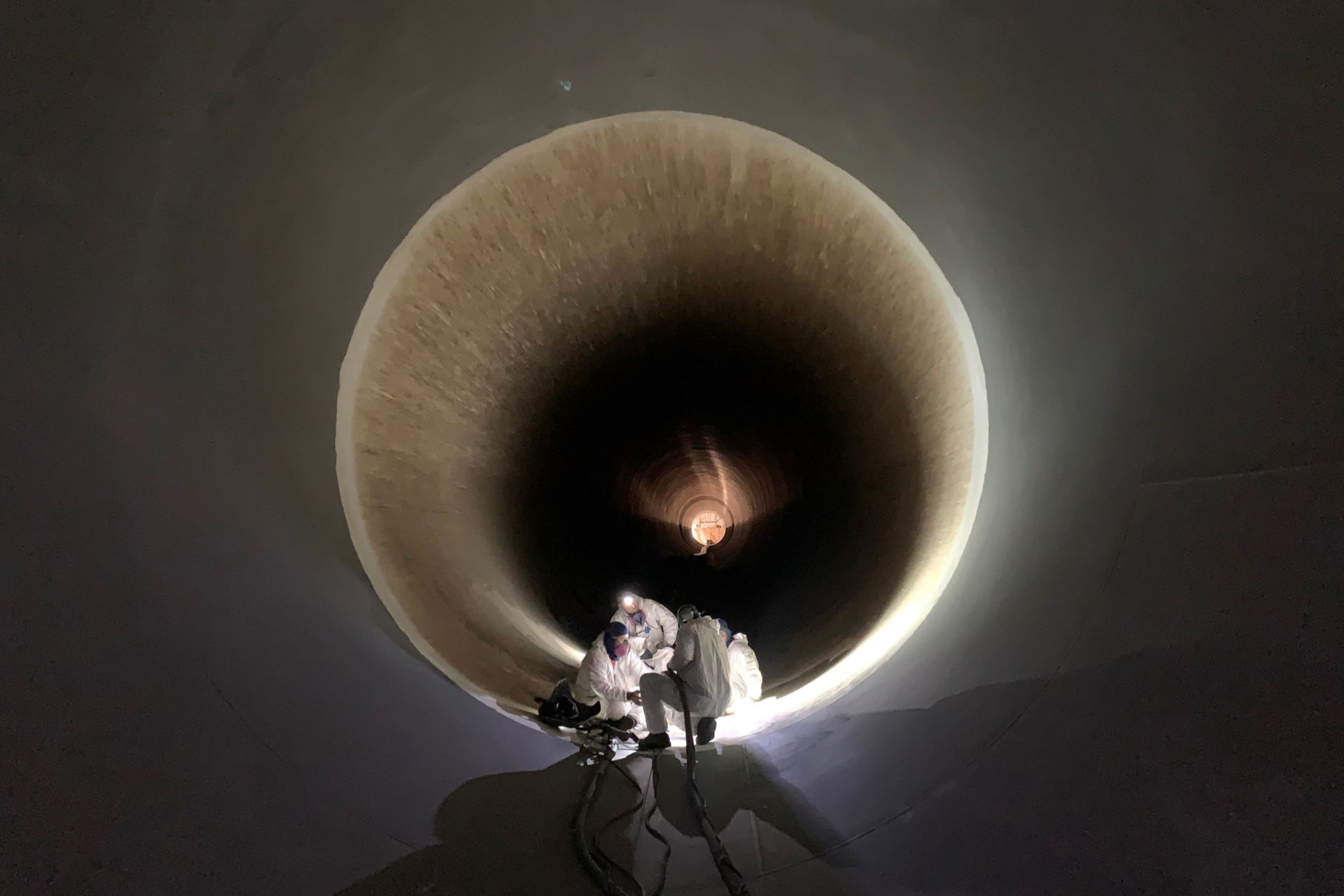
and any contaminants to enable proper adhesion of the new lining.
Photo courtesy of F.D. Thomas
Restoring the Penstock
Surface preparation required both manual and robotic blasting. Crews removed the tightly adhered original coating and prepared the entire interior to an SSPC-SP 5 white metal blast clean condition (Figure 2).
Progress was slowed by the tenacity of the existing lining and mill scale on upper portions of the pipe, but the sequencing strategy helped maintain momentum: some crewmembers could blast and prepare one bulkheaded section while others lined an already prepared section. Logistics remained difficult throughout the project as equipment and materials had to be lowered by crane from the access shaft or carried up the staircase. Spray hoses also had to extend as much as 1,000 ft to reach working areas while minimizing moves inside the confined space.
Once the old lining was removed, inspectors found the steel in relatively good condition, with minimal pitting and few repairs required. For the replacement system, the owners specified Sherwin-Williams Sherplate PW Epoxy, a 100 percent solids epoxy amine lining selected for its high build, edge retention and suitability for immersion service. The material also contains no solvents, an important benefit in a confined space where air quality is critical.
Crews first stripe coated welds, edges and corners, then spray-applied the lining in a single pass to achieve a minimum dry film thickness (DFT) of 30 mils. They completed applications both manually and robotically, depending on location and access.
Inspection and timing were equally important to success. Inspectors performed holiday spark testing across the full interior lining surface, with only limited touchup required (Featured Image Above). The coating’s 14-day recoat window simplified repairs, and its 24-hour return-to-service capability proved especially valuable because both outage periods were extremely tight. The team worked almost to the moment the penstock had to be returned to operation (Figure 4).
Bay Area Coating Consultants, Inc. served as the owner’s inspection representative, verifying preparation, environmental conditions and final film thickness while helping keep the job moving through direct access to active work areas.
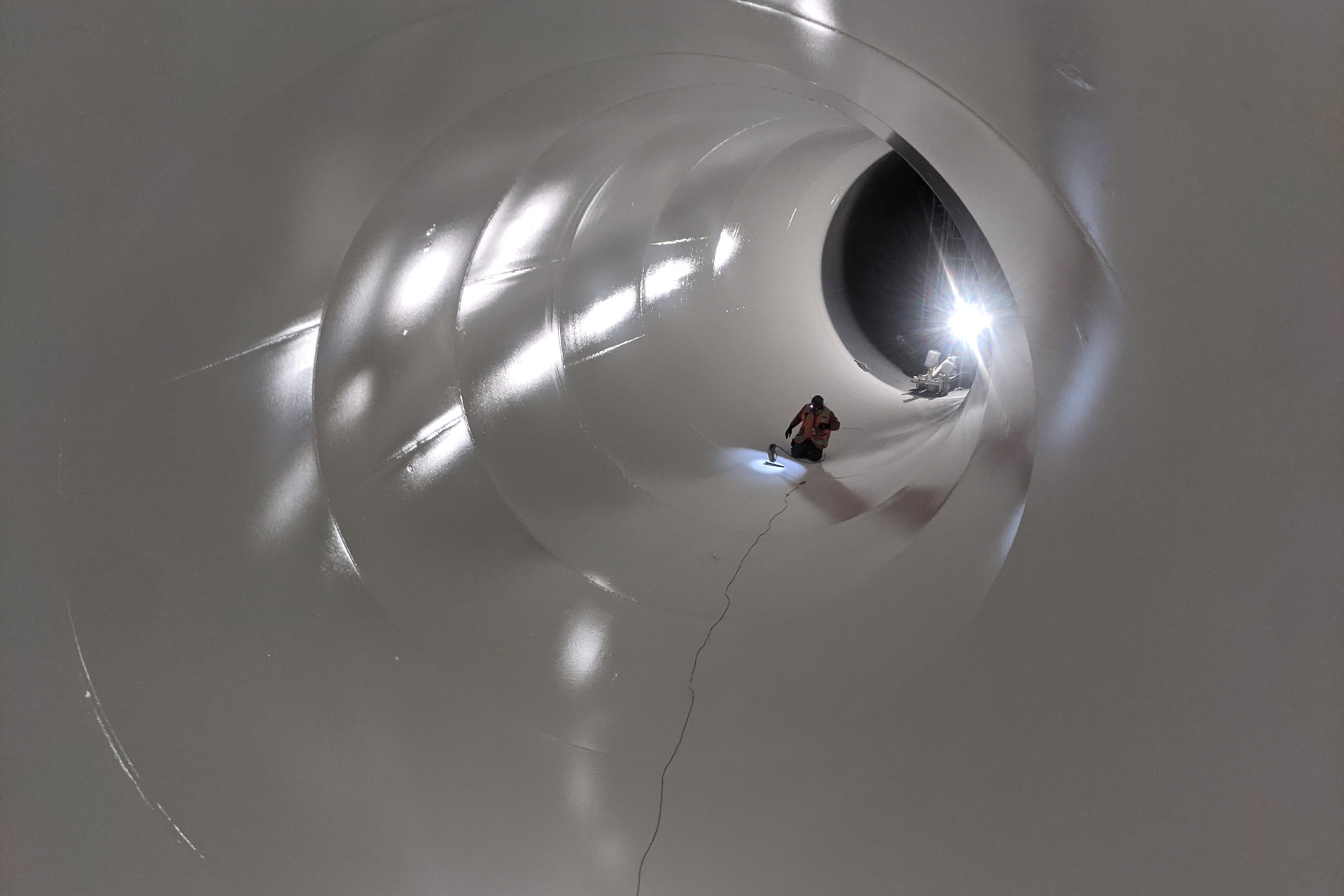
progress on the full lining installation.
Photo courtesy of F.D. Thomas
Gaining A Second Life
Despite severe access constraints, lead containment requirements, water intrusion, remote logistics and hard shutdown deadlines, the crew completed the project on schedule over two construction seasons. The restored penstock is expected to provide at least another 50 years of service, effectively doubling the lifespan of this critical infrastructure component. Just as important, the project demonstrated how careful planning, specialized contracting expertise, robust safety controls and a high-performance lining system can extend the life of aging hydroelectric assets without compromising operational reliability.
For owners of legacy water and power infrastructure, Don Pedro stands as a strong example of how disciplined rehabilitation can preserve value, reduce risk and support long-term clean energy generation.
Scott Helfand is a senior sales representative for Sherwin-Williams Protective & Marine.
Latest Posts
- PG&E Files 10-Year Electrical Undergrounding Plan
- HDD Contractor Faces Tough Rock Drilling Under the Illinois River
- Vortex Companies Expands its UK Footprint

- Sprayable Linings Used in Municipal Sewer Manhole Rehabilitation
- AEM Manufacturing Express Celebrates American Augers Workforce in Ohio
Next Up
HDD Rodeo | December 2-4, 2026 | Perry, Georgia | Learn more
HDD Academy | February 18-19, 2027 | Scottsdale, Arizona | Learn more
Microtunneling Short Course | May 4-6, 2027 | Scottsdale, Arizona | Learn more
Water Finance Conference | August 3-4, 2027 | Cleveland, Ohio | Learn more