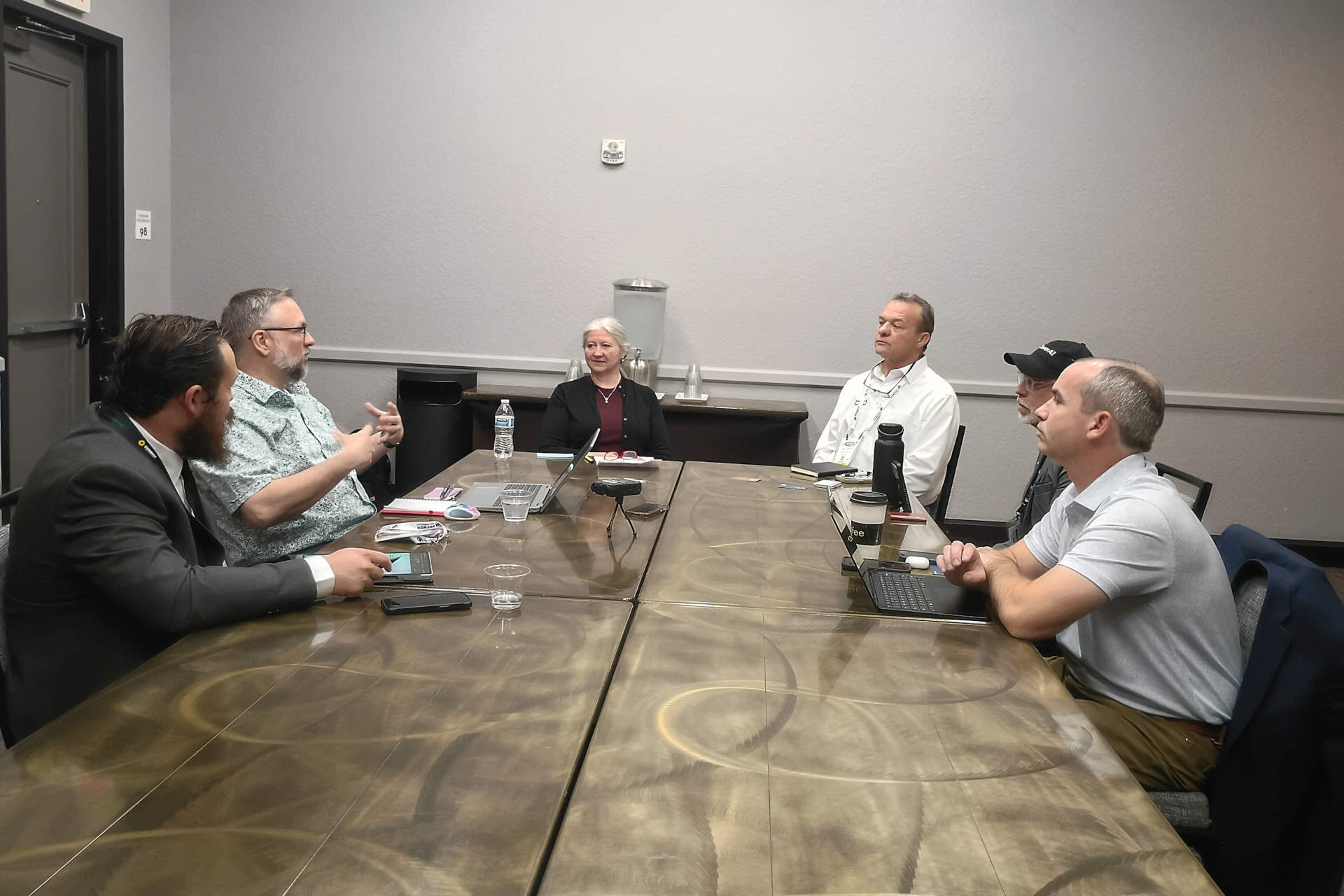
2026 Trenchless Technology Editorial Roundtable
Perspectives Across the Trenchless Career Lifecycle
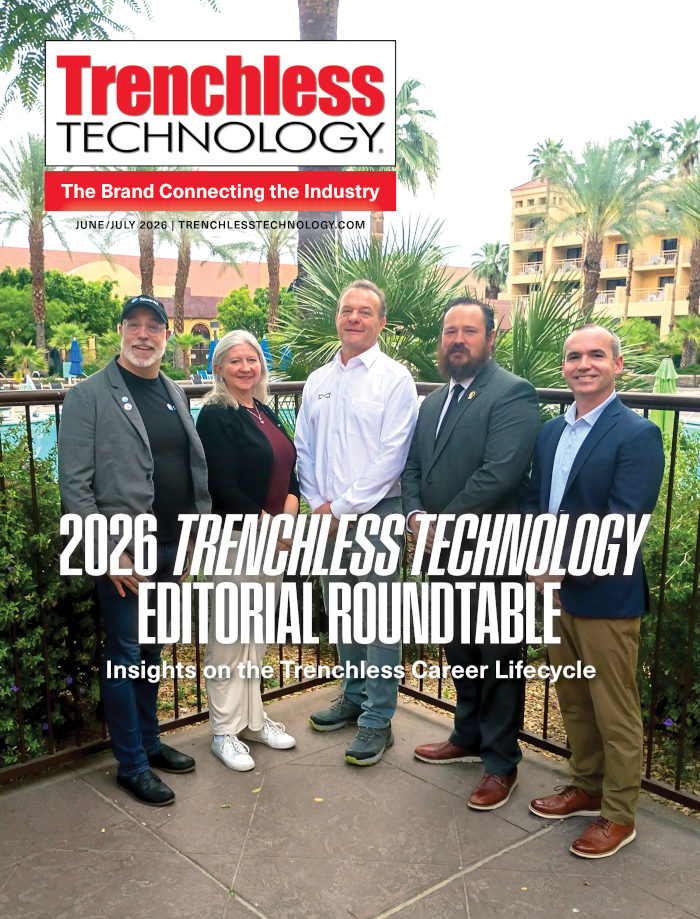
Held annually, Trenchless Technology’s roundtable is an intimate gathering meant to foster an open discussion among peers about the status of the North American trenchless sector. Our themes evolve each year to offer readers a varied look while hitting on key topics relevant to entire industry.
For 2026, we gathered a varied group of trenchless professionals meeting in Palm Springs at the NASTT No-Dig Show to discuss the theme, “Perspectives Across the Trenchless Career Lifecycle.”
As the theme suggests, we spent an hour chatting about the panel members’ entry into the trenchless world, the challenges they have faced, the importance of mentorship and much more.
Taking part in the panel are:
- Mark Gallucci, Customer Insight Manager, Digital Control Inc.
- John Kraft, Ph.D., Lecturer Louisiana Tech University and Director of Special Schools at the Trenchless Technology Center
- Michelle Macauley, P.E., Founder and Managing Partner, Macauley Expert Services
- Eric Sullivan, Director of Strategic Development, SewerAI
- Webb Winston, P.E., Vice President & Senior Practice Leader – Energy Pipeline & Trenchless Engineering, GEI Consultants Editor’s Note: At the time of the Roundtable, Winston was with Williams, some of his remarks may reflect his work there.
Below, you’ll read a truncated version of the discussion. For the full version, visit digital.trenchlesstechnology.com/june-july-2026/page-12.
What is your current role? What initially drew you to the trenchless/underground infrastructure construction industry?
Michelle Macauley (MM): I am the managing partner at Macauley Expert Services, a company I started. I provide geotechnical engineering services for trenchless projects, general consulting and I do a lot of expert witness services and litigation support.
What really drew me into trenchless was working as a general geotech for many years. I loved doing the general geotech, deep foundations and retaining walls. But with trenchless, geology drives so much of the risks, mitigation and how we approach the project. So, I really felt like I was contributing more to trenchless projects with my undergrad in geology and master’s in engineering coming together for trenchless. And I really like how you have to really know the soil and the soil conditions and the groundwater conditions to provide a good product for the client.
Mark Gallucci (MG): Next week, marks 30 years at DCI. As customer insight manager I conduct dozens of interviews each year with customers. I report to the design engineers, project managers, and ownership at DCI. I help identify the needs gap between what the contractors really need and what DCI produces. My job is to close that gap.
I started in the industry almost on a whim, really, to travel. My career started in 1989 with the Robbins Co. out of Kent, Washington. I was visiting my girlfriend, now my wife of almost 36 years, and I met a gentleman named Don Ballard. He showed me photos of work in Norway and told me that I should go down and talk with the people at Robbins. They were looking for people, but I knew nothing about tunneling, hydraulics or mechanical systems.
We had the same conversation about three months later, so I went down to Robbins, had an interview and I left and really thought nothing about it.
An hour later the gentleman who interviewed me called and asked if I was a smoker. That was a strange question, but I said no. He said, “Okay Mark, I’ve got you booked in a non-smoking seat. You leave for Norway on Sunday.” This was a Thursday. I spent 32 of the next 36 months living above the Polar Circle in Norway on a 55-km tunnel boring project in some of the world’s hardest rock.
It happened just like that. It’s funny how your life can change on whim like that.
Eric Sullivan (ES): I am the director of strategic development at SewerAI. We build AI-powered software for sewer inspection and condition assessment. I am also a NASSCO certified trainer for PACP, LACP, and MACP.
And I came up really through the data and CCTV-focused part of our industry. Working video inspection and data of conveyance systems and gravity sewers. I got really deep into NASSCO standards and became PACP-certified in 2008. Eventually, I found myself becoming a trainer in 2012. And this year, I was named NASSCO Trainer of the Year.
In 2019, I connected with the founders at SewerAI. I found myself at the intersection of inspection, data collection, and emerging technologies for sewer assessment. I guess what hooked me about this industry is that the work we do really matters. It also matters how you can draw insights from things that are literally hidden from view.
Webb Winston (WW): Williams is a natural gas pipeline owner with over 33,000 miles of pipelines in about 26 states. Williams transports about 33 percent of the natural gas in America.
My role as principal engineer is as the subject matter expert focused on trenchless installations. That’s horizontal directional drills (HDDs), bores, Direct Steerable Pipe Thrusting, and other trenchless methods for our new installations for expanding the natural gas pipeline infrastructure and also replacing existing infrastructure.
Getting started in the industry, I actually interned out of college in the trenchless industry. I was working as a civil engineering student working in the transportation sector. The trenchless opportunity came up to intern during the summer before my last semester of my senior year. The number one thing was, hey, you’re going to be able to travel. Similar to Mark, the travel hooked me. And at that time, I didn’t know that wasn’t the most exciting part about the industry.
John Kraft (JK): I’m a lecturing professor of civil engineering and construction engineering technology at Louisiana Tech University, while also being a researcher and director of special schools at the Trenchless Technology Center (TTC).
So, while I teach some courses in civil engineering and construction, I get a lot of fun out of my work at the TTC with the research projects that include new product and methods development, rehabilitation, QA/QC, and third-party testing. We also do a lot of training.
That’s part of what got me into trenchless and kept me here. I completed grad school at LA Tech. I was in the middle of it, and stuck with it.
During grad school I was able to travel and do a lot with NASTT because of shows like No-Dig and other things. I met tons of people throughout the industry and was exposed to all sides of it, and I liked all of it.
The TTC work allows me to work with everybody. I’m not stuck in one place. Depending on what we are doing research-wise, I could be in Colorado or Florida testing styrene or somewhere else bursting a pipe in a yard in Cincinnati.
It has allowed me to chase whatever I want to do. There are tons of possibilities.
Who would you say was a mentor to you? What made them a good mentor?
MG: I was the fifth of five people to jump from The Robbins Company to Digital Control, so, some of the very same people that were, showing me the ropes when assembling tunnel boarding machines and fine-tuning these tunnel boarding machines, beat me to DCI. These were the same people showing me the nuances of walk-over locating. And probably more importantly, how to be a better trainer, how to be an instructor. You’ve heard of guilt by association; I’m expertise by association.
ES: I’ve had a few awesome mentors, and I’ve been lucky for that. John Jurgens was my first PACP trainer and I’ve learned a ton from him. He was one of the original people in the room who helped create PACP.
Larry Kiest, Jr., I was able to meet him pretty early on when I got started in the industry and he ended up giving me a job years later. A couple of people on the NASSCO side are Jerry Weimer and Ted DeBoda. These are people who really trusted me to be in rooms that maybe I thought I wasn’t ready to be in.
They taught me the importance of trusting someone else to be able to take something on. I also learned that it matters to have technical knowledge and credibility to add value to the conversations you are in.
WW: Someone who comes to mind is a director of engineering I had as my boss early on in my younger years. One thing that stood out was that he was very level-headed. Even when things would go awry, so to speak, or when we had challenges. As a younger engineer I was more prone to getting excited or discouraged about something when things didn’t exactly go as planned. He didn’t overreact. He knew how to calm the situation and keep everybody on track. One thing that he passed down is to treat people with respect. Assume that everyone has good intentions, and that everyone is all in this together. Everyone is trying their best to carry out the mission. And if everyone respects each other and treats each other with respect, you’ll all pull together and get through it a lot of times.
MM: I feel I was really fortunate because my first 100 percent, fully trenchless career was with Bennett-Staheli; nd I’m sure everybody here knows Dave Bennett and Kim Stahali. They’re proponents of giving back to the community, volunteering, presenting in conferences, getting involved in committees, authoring papers and training. So, it was a really awesome opportunity to both get involved early on and to get that networking.
Dave Bennett has been a continuing mentor. And what really makes him stand out is it wasn’t just when I was an employee of Bennett-Staheli. He’s continued to mentor all through my career. In fact, we were expert witnesses together. And he was mentoring me on how to be a better expert witness. Which is a really telling sign from someone who was willing to help someone who could be their competition.
There weren’t a ton of women mentors when I was coming up through the industry. So, I pretty much just asked people what they thought. I asked their opinions and listened. And little did they know that they were mentoring me when I was doing that. It wasn’t a formal mentoring process. It was more me approaching people that I knew and respected and asked their opinion.
When I think of my mentors from an early age, I would ask people when I had these forks in my career where I had a decision. Ralph Boirum, who was one of my first principal engineers as a geotech, he said I should meet this new engineer, Kim Staheli because she’s going places. Or when I was considering changing companies, asking one of the more advanced marketing directors from a prime engineer, what do you think of this firm I’m considering? And even when I wanted to start my own company, having people at Jacobs who were proponents and say, here, let’s help you do this. I feel like everybody really wants people to succeed in this industry. We all want a good product, and we want smart people working on these projects.
I find mentors everywhere. I find that I can learn something from everybody I interact with, and really just take that to heart. Even Webb and I worked together at Geo Engineers, and I can give you a number of mentors at Geo Engineers who are good people, smart people who are willing to share their knowledge and expertise to make everybody better.
JK: There are many mentors. I started out in this area early, and one of the first, and he’s been there the whole time, is Dr. John Matthews at Louisiana Tech and TTC. He really got me started. Dr. Shaurav Alam really pushed me academically and technically to learn everything I possibly could. On the professional side, John Matthews exposed me to everyone who he had met over the past decade plus of time.
He empowered me, or gave me the opportunity, by putting me in charge of projects – when I was in grad school – that I don’t know if I would give to a guy at my level. He was like yeah, you got this. Go out there for a couple weeks and do this and do that. Through things like that, I made a lot of connections, and those people turned into mentors, and I learned a lot from just being put out there and meeting all these different people. There have been a lot of mentors, there certainly have.
How have you mentored people in the trenchless industry?
JK: A lot of what I’ve done has probably been exposing students to something that they probably wouldn’t see anywhere else. I work trenchless problems into the majority of my classes. And I really like getting them out here in front of folks at shows like No-Dig and UIC to introduce them to the industry. I am trying to bring some of these folks right out of school, get them involved, and grow our industry.
MM: I remember my first conference. And I didn’t know what I was doing. I didn’t know anybody. I didn’t really know how I was supposed to do when you conference. They don’t teach networking at college.
I remember feeling a little lost in a drift. So, when I see students at conferences, and if they look a little lost, I go up to them, say hi and ask how they’re doing. I really do try to proactively seek out students.
Fortunately, in my roles whether it’s previously on the NASTT Board of Directors or now the Executive Committee of UESI Pipelines, I try to incorporate opportunities at the conferences to educate students about what to do. Encourage them to go out and talk to people they don’t know. Ask questions. Get to know people on a personal basis.
I also encourage them, if they don’t already have one, to create a LinkedIn account. And the goal is not to connect LinkedIn contacts like they’re collecting Pokémon cards. It’s to actually develop a relationship.
Another way is I seek out younger women engineers. I ask them what their goals are here. I know a lot of people so I ask them who I can introduce them to. Just yesterday, I spoke to a woman who was finishing up their master’s and asked them what they wanted to do. She said she was hoping to get an internship. I told her I would talk to some people and sure enough, I introduced her to a person and hopefully she’ll have an internship.
MG: I don’t think I’ve been a mentor in traditional sense. But I’ve certainly helped people along the way. And I do that by being consistent with my message and my actions. You can’t shy away from the difficult conversations. I’ve had a lot of people report to me in my years at DCI, and you have to take them aside in a manner that is positive. You don’t want to blow somebody up because that’s not going to work. Point things out in a tactical way.
That’s worked for my coworkers, for countless dealership people who I’ve come across, and certainly with drill crews. You tell them there is a better way. I ask them to let me point things out and explain it to them. For the most part, people have been exceedingly receptive.
At the end of the day, they’re appreciative, and they’re better off for taking that little bit of effort.
ES: From my perspective, being willing to connect a person who’s new to our industry to other people in our industry. Being willing to drop names of folks. And also referring them to things that I know about that are related to what they’re interested in. You meet them where they’re at and I try to deliver a response that’s not just overly informative but tries to home in on what it is that their question was about. And let people ask lots of questions and lots of different types of questions.
Echoing what Michelle said about the importance of social media and being out there as a public person and being available for people to connect with. It lends itself to folks approaching you and being able to connect people to each other.
WW: One thing we started at Williams several years ago is a program called Experts to Nextperts. It’s a way of encouraging people with a certain level of expertise to share that knowledge and focus on a sustainable knowledge bank within the company. It helps people professionally develop an expertise if they have an interest in it. We found that the experts training other people build some acumen. The people that are learning, the mentees, if you will, are also developing that.
We got project engineers or project managers that may have a trenchless project every once in a while, but really gravitated toward and enjoyed it, to learn more about trenchless. We identified other subject matter experts within the company to share some of their knowledge down to the folks who are interested in that topic. They really found that valuable. Sometimes people get stuck in a rut. They feel like they’re not going anywhere and they’re not learning. And they feel like they’re just doing projects and can’t get anywhere. They found this valuable.
I’d say the next thing is just establishing a relationship with folks on a personal level. We use the cliché work-life balance, and there’s a lot to be said about that. If you really don’t understand people’s life situations and the challenges that they’re faced with, you may push somebody to do something without really understanding what else is going on with them. So, developing those relationships technically, but also personally, makes going to work and the jobs go a lot smoother, and everybody feels better about working with the team.
What is one thing you wish somebody would have told you earlier in your career?
ES: I think about this frequently and that is to relate to everybody like they will work with you, or you might work for them, or they might work for you someday.
We could all agree that our industry is very dynamic. There are a lot of company acquisitions happening. There’s a lot of people moving around in different roles across different organizations. For myself, it’s certainly been the case where someone who I might have randomly met and became buddies with, fast forward a few years and we’re co-workers. Or people who I was co-workers with became competitors, and now we’re co-workers again.
WW: It’s okay to fail. Earlier in my career I was probably more under the impression that failure is not an option. You think from an engineering and construction standpoint that everything has to be perfect.
Catastrophic failures can be very devastating, and that clearly needs to be understood, and care needs to be taken. But, people need to understand that it’s okay to fail. But when you do, it’s important to learn lessons from those and apply them for the next project. If you do this, you end up with a better product.
So maybe you don’t feel comfortable going out on a limb and taking on something that you think, hey, there’s a strong chance that may not work. I think if you understand and if the message is shared that it is okay to fail, as long as you apply lessons learned, it allows people to expand themselves a little bit
JK: I think I was probably told this but just ignored it at first and that’s to meet as many folks as you can.
Because, like Eric said, maybe they’ll work for you one day or maybe you’ll work with them. Or maybe you’re going to team up on a project. The more people you know, the more involved you get with committees or other things, it could benefit you later.
Try to be friendly and there’s no telling where it might take you. Put yourself out there, get involved. Just do it.
MM: The main thing is — and I was told this early on and probably didn’t pay as much attention to it — keep your resume updated. You work on these projects and two years later, two months later, two days later, you might not remember what you did on it.
And if you’re working on one huge project, keep track of the tasks or the subtasks that we’re working on. It just makes it easier that if you decide to move or change positions later, you have it updated.
One thing I heard is the only way to climb a ladder is to change rungs. You have to let go of a rung and go to another rung. I’ve changed companies more than my mother is comfortable with, but every time I moved positions, I was moving to a slightly higher or better position in my mind. So, that’s one thing I wish I would have known sooner.
In all things, have integrity in how you operate. How you leave a company is just as important as how you join a company. So, always think about how you come across and have integrity in all your actions.
For the full version, visit digital.trenchlesstechnology.com/june-july-2026/page-12.
Mike Kezdi is managing editor of Trenchless Technology.
Latest Posts
- HDD Contractor Faces Tough Rock Drilling Under the Illinois River
- Vortex Companies Expands its UK Footprint

- Sprayable Linings Used in Municipal Sewer Manhole Rehabilitation
- AEM Manufacturing Express Celebrates American Augers Workforce in Ohio
- SprayWall® Restores Pennsylvania Twin Barrel Culverts While Keeping Roadway Open
Next Up
HDD Rodeo | December 2-4, 2026 | Perry, Georgia | Learn more
HDD Academy | February 18-19, 2027 | Scottsdale, Arizona | Learn more
Microtunneling Short Course | May 4-6, 2027 | Scottsdale, Arizona | Learn more
Water Finance Conference | August 3-4, 2027 | Cleveland, Ohio | Learn more