NASSCO Report – FFRP Trenchless Rehabilitation of a 9,100-ft Raw Water Transmission Main
This article examines the decision-making process for selecting the flexible fabric-reinforced pipe (FFRP) methodology for trenchless rehabilitation. In particular for pressure pipelines with complex profiles and in challenging topographical environments.
It also underscores the benefits of employing FFRP technology, particularly its capability for installation within a constrained timetable. This showcases its innovation, speed, and sustainability. It serves as a valuable model for similar infrastructure projects.
Since the construction of Pennsylvania American Water’s 9,100-ft raw water transmission main in 1943, the pipeline has been transporting raw water at 100 PSI. It moves from the pump station’s intake at the creek to a reservoir adjacent to the treatment plant. This vital infrastructure is responsible for replenishing the water supply. This supply is subsequently treated and distributed to customers in Chester and Lancaster counties, Pennsylvania.
The original cast iron transmission main was laid across demanding terrain characterized by steep hills and narrow, winding roads. It consisted of a 4,650-ft segment of 16-in. pipeline. Then it transitioned to a 12-in. segment at a valve vault and extended an additional 4,450 ft. The pipeline’s intricate profile featured 13 horizontal bends, numerous vertical bends, several intermediate air release valves, burial depths reaching up to 15 ft, and slope differentials approaching 100 ft.
2007 Upgrades, 2024 Rehab
In 2007, design upgrades were completed for the pump station and intake structure to increase the water main transfer capacity from 1 million gallons per day (MGD) to 4 MGD. This was in response to rising demand.
By 2024, following eight decades of operation, the pipeline’s performance was significantly compromised due to leaks and extensive tuberculation. This necessitated a comprehensive rehabilitation approach that would address all project requirements.
Rehabilitation efforts, which began in mid-September 2024, were further complicated by numerous challenges. These included the rugged natural landscape, the complexity of the pipeline’s alignment, and restricted working hours between 9 a.m. and 3 p.m. However, limited logistical access added to the difficulties. These difficulties were compounded by an unprecedented 130-year historical drought, which significantly heightened the risk of forest fires in the area. It necessitated returning the water main to service no later than the end of October.
Selecting FFRP
Following a comprehensive evaluation of all project factors and close collaboration between the engineering, construction, and technical teams at J. Fletcher Creamer & Son Inc. (Creamer) and the water company, the FFRP method was selected. It was chosen as the optimal long-term solution using the Primus Line system.
FFRP has a robust and flexible construction, enabling installation through multiple bends and in continuous lengths of up to 8,200 ft. This capability significantly reduces the need for access pits. It also minimizes the overall installation footprint. Furthermore, the technology also efficiently accommodates high internal operating pressures independent of the host pipe, as it does not rely on adhesion or curing processes.
Creamer launched the rehabilitation project in close coordination with the client and the local department of transportation (DOT). The finalized plan included site preparation, equipment mobilization, excavation, transporting machinery and materials, traffic control, and road closures or detours. These measures were carefully designed to ensure community safety, minimize disruptions, and enable efficient project execution.
Rehab Commences
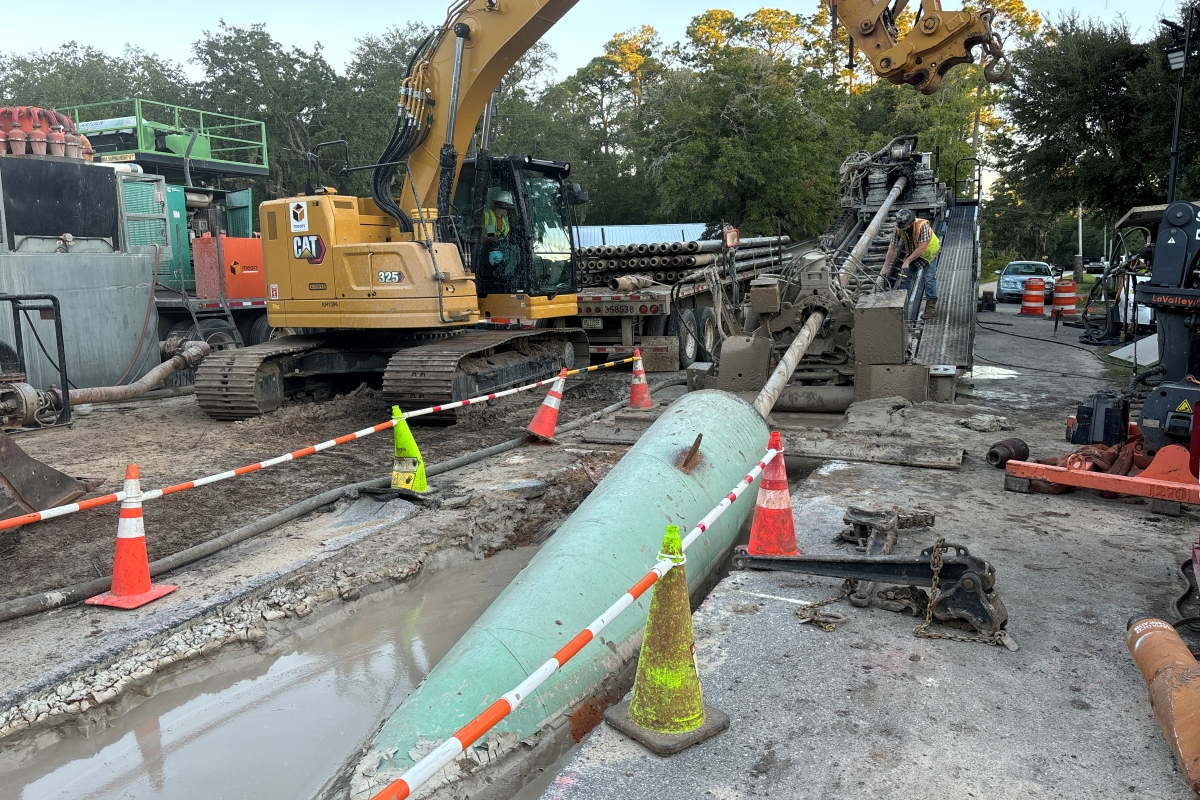
In mid-September, Creamer crews commenced operations by excavating 10 lining pits to cut the water main at each location. They provided necessary access for cleaning and CCTV inspection.
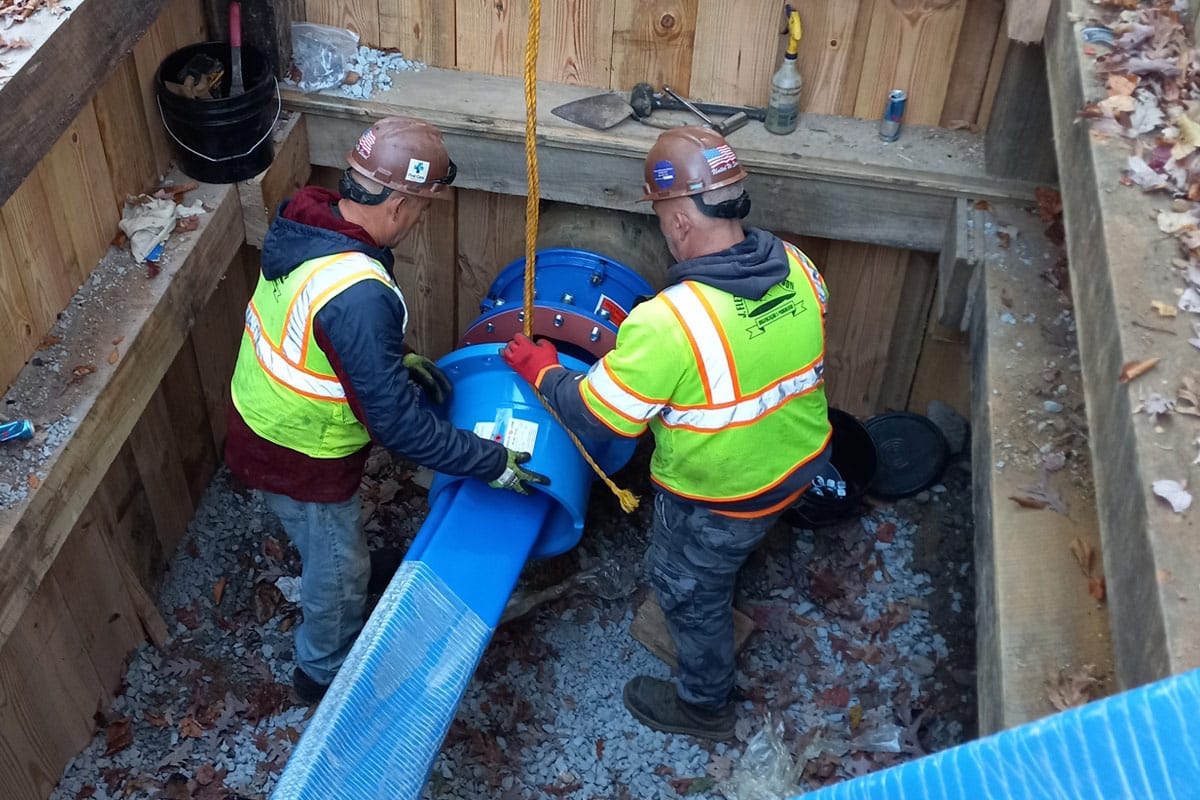
The pre-cleaning CCTV inspection found protruding bolts from a past repair on a 16-in. pipeline, about 147 ft from the pump station. This required extra excavation to remove them and install a pipe spool. The post-cleaning inspection confirmed the pipeline was ready for liner installation.
Ultimately, a total of seven liner lengths were installed: four within the 16-in. pipeline segment measuring; 580, 1,350, 1,625, and 1,085 lf. Three were within the 12-in. pipeline segment; measuring 650, 1,250, and 2,100 lf.
The rehabilitation and pressure testing of the entire raw water main was successfully completed over a period of less than two months. The pipeline officially returned to service on Oct. 29, 2024, right on schedule.
- Don’t Miss the UESI Pipelines 2026 Conference in Detroit

- UV CIPP Scales Up for Large-Diameter Culverts
- Learn how a Vermeer 24×40 HDD helped a contractor grow
- Kondex Cited as Best Downhole Tools
- Tri-Con™ Drilling System: Redefining Speed and Strength in HDD Tooling



Next Up
2026 Microtunneling Short Course | May 5-7, 2026 | Scottsdale, Arizona | Learn more