CIPP Collaboration Restores Major MDOT Culvert Crossing
A coordinated effort between manufacturer, contractor and owner overcame complex logistics and site conditions to rehab three 99-in. culverts under highway M-43 in Lansing, Michigan.
The Michigan Department of Transportation (MDOT) owns and maintains nearly 30,000 highway culverts and structures across the Mitten State.
Inliner Solutions has a history of partnering with MDOT to extend the life of those critical assets.
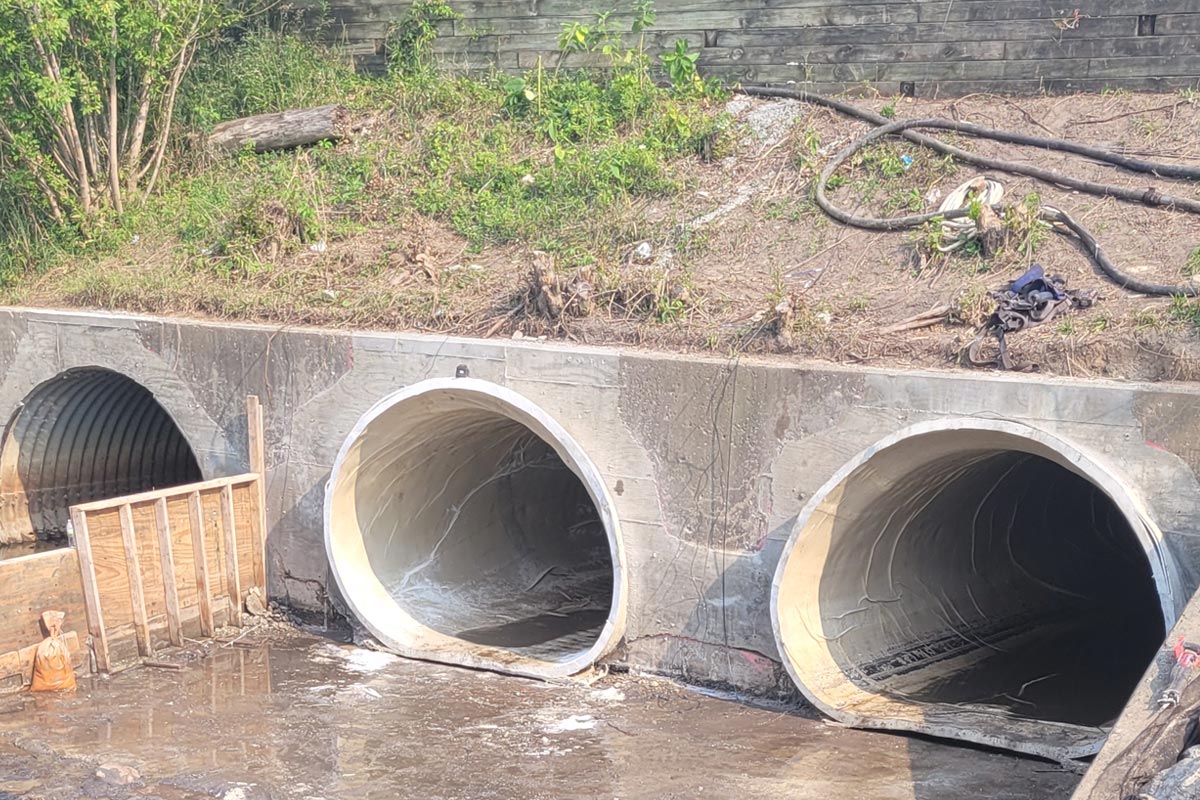
A recent success story took place in Lansing, Michigan, where Carrier Creek passes beneath highway M-43. The creek is substantial and requires an impressive culvert crossing consisting of three arch-shaped CMP pipelines measuring 114 in. wide by 77 in. tall (99-in. equivalent round diameter). The CMP was nearing the end of its useful life. Therefore, a CIPP rehabilitation project was awarded to Davis Construction with Inliner Solutions providing the installations.
CIPP lining at this scale presents a few challenges to overcome. Let’s discuss the challenges of logistics, access to the site, and communication.
Logistics
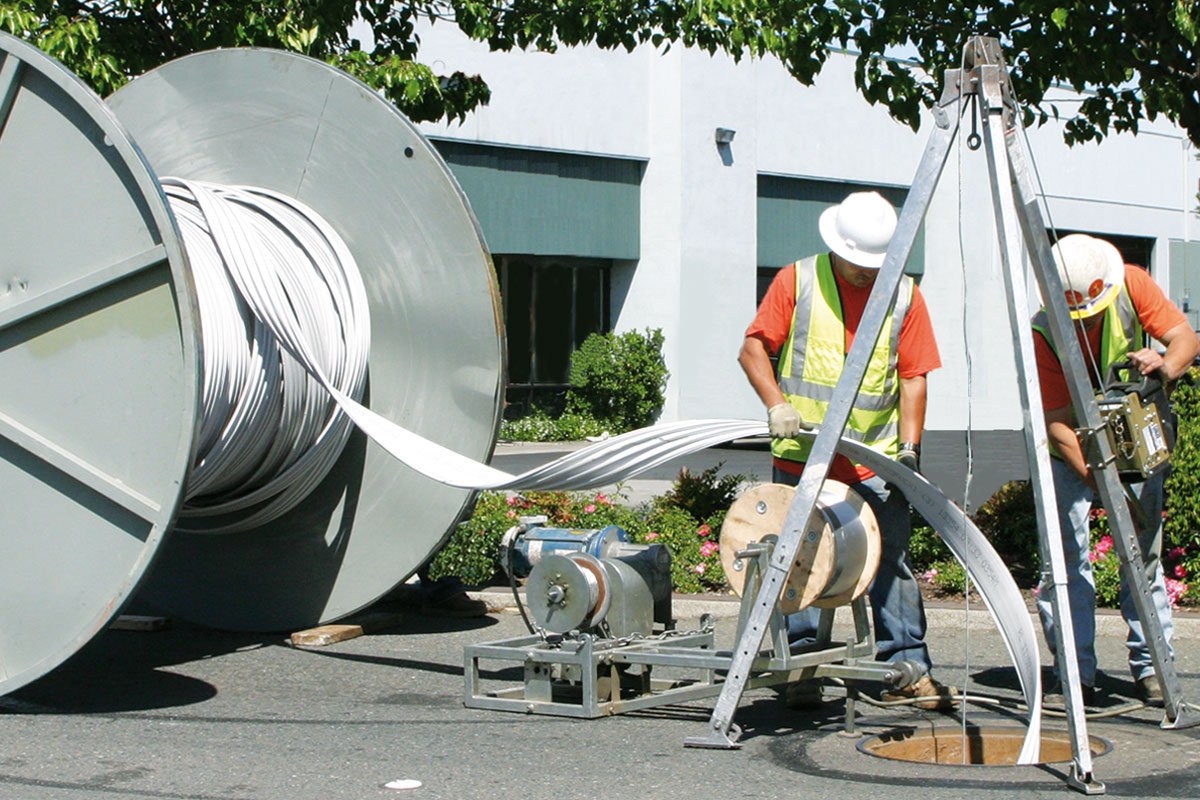
A 99-in. CIPP liner weighs several hundred pounds per foot and lays flat at nearly 13 ft wide. Special DOT permitting required a 530-mile route assigned by the States of Indiana and Michigan. Furthermore, the liner must also remain chilled from wetout to installation. This is a challenge in and of itself over such a lengthy trip in 90-degree, August heat. A custom flatbed trailer was utilized with seven axles, 14 feet wide. It was packed with ice and insulation, and sealed tightly to ensure safe delivery of the 132,000-lb gross weight.
Site Access
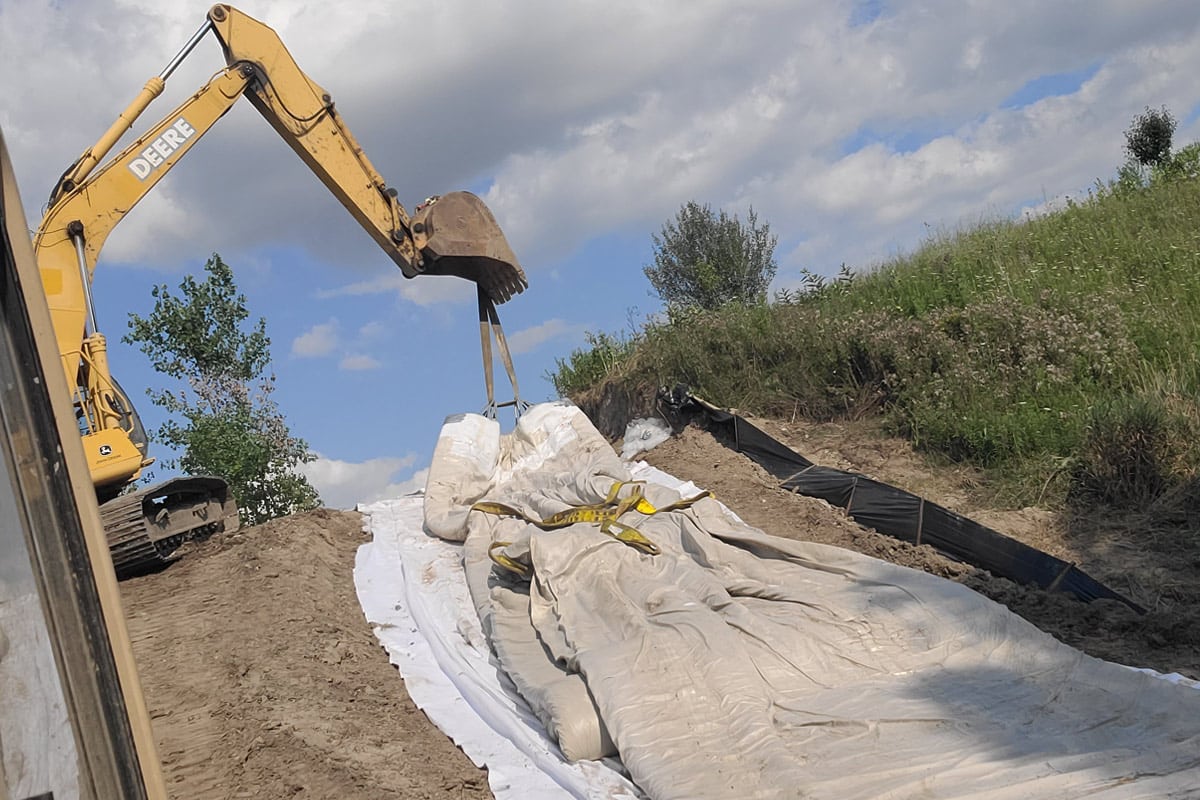
It would be a feat to install 99-in. CIPP in a flat, open parking lot. Highway culvert sites, however, are neither flat, nor open. Picture a busy, four-lane highway with an elevated road surface. Steep side slopes fall 20 ft down to the culvert invert. Furthermore, a private wooden fence was between the highway and the culvert. It could not be disturbed and a semi-trailer and tractor could park no closer than 250 ft from the culverts. Inliner was limited to a narrow temporary right of way. They had to maneuver equipment and the liners down to the culvert for installation. Bypass of Carrier Creek was handled by Davis Construction. They used sheet piling to divert flow into adjacent culvert barrels. Through all this, M-43 remained open to through traffic in both directions.
Communication
Perhaps the most impressive aspect of this project is the communication and collaboration that took place. Inliner Solutions merged crews, equipment, and expertise from its Detroit, Michigan, and Orleans, Indiana, operations. This came together beautifully to achieve a common goal. Davis Construction was excellent to work with, incredibly supportive and professional. MDOT was appreciative of the effort and the results. It’s a good sign when the owner brings their grandkids to watch an installation.
The CIPP installations were successfully completed in August 2025. They were done back-to-back-to-back, spanning just 10 days. The project was delivered under budget and ahead of schedule.
Project Highlights
Environmental
• Ambient temps were mid to upper 90s for all wetouts, transports and installs.
• Lansing received significant rain event during the project. The creek flash flooded and overran our sheet piles used to divert the creek flow.
• Additional precautions were taken to prevent any resin or condensate water entering the creek.
Project Site
• Due to terrain, we could not get our semi-trailer closer than 250 ft from our inversion platform. Additionally, MDOT did not want to disturb a wooden fence parallel to the roadway.
• We were limited to a narrow right-of-way access. I believe it was 25 ft.
• We closed one lane of traffic in each direction to accommodate our equipment package.
• Stream was diverted with sheet piling.
Tube
• The pipes were flat bottomed arched and in poor condition. Liners were 99-in. x 70.5-mm.
• We installed with air inversion and steam cure method.
• Cures were monitored by Vericure.
• Additional precautions taken to prevent blistering from exotherm temperatures due to the thickness of these liners.
Eric Haenlein, P.E.,Vice President of Engineering at Inliner Solutions/PURIS