Why Gyroscopic Guidance Should Be Considered During HDD Planning
Horizontal directional drilling (HDD) projects are becoming increasingly complex as installations move into congested urban corridors, deeper crossings, and tighter rights-of-way.
These conditions place greater demands on positional accuracy, safety, and confidence in bore navigation. Despite this shift, guidance system selection is still often treated as a secondary planning consideration. Walkover systems are assumed to be sufficient unless field conditions dictate otherwise.
Gyroscopic guidance is frequently introduced only after traditional navigation methods encounter problems on the jobsite. This reactive approach increases risk, inefficiency, and cost. However, modern gyroscopic systems now make it practical to consider advanced guidance systems during the planning phase. This is particularly true for projects where accuracy, safety and reliability are critical. When specified upfront, gyroscopic guidance can reduce overall project risk and, in many cases, total cost.
Traditional Guidance Assumptions in HDD Planning
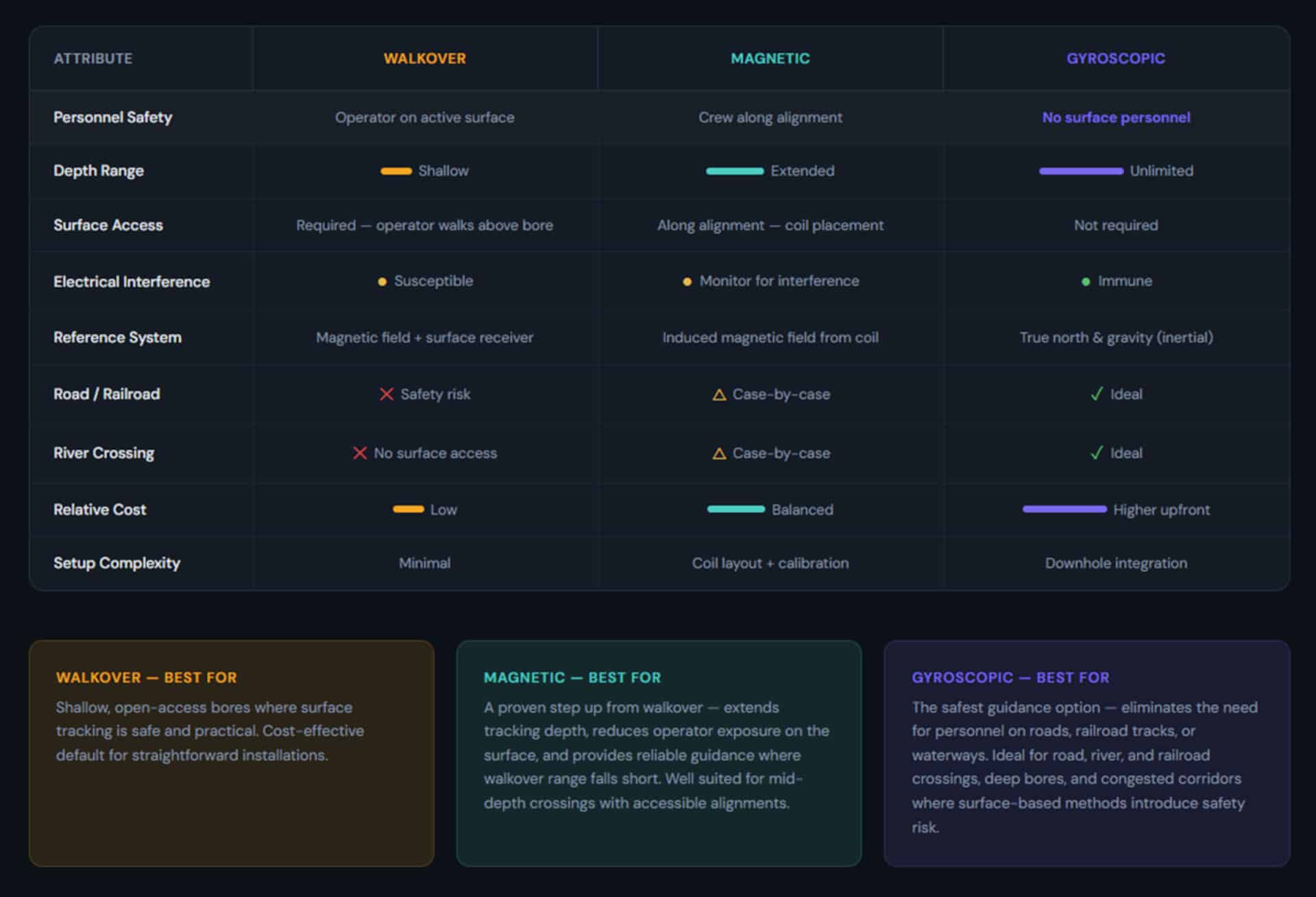
For decades, walkover systems have been the primary navigation method for HDD, especially on shallow bores with clear surface access. When depth remains within tool limits and crews can safely follow the bore path, walkover tracking performs well and is cost-effective.
However, these assumptions do not hold for many modern installations. Road crossings, railroad corridors, river crossings, and congested urban rights-of-way often restrict surface access or introduce safety concerns for personnel required to track the transmitter. Depth alone can exceed the effective range of walkover systems, particularly on long or curved profiles. In addition, magnetic interference from utilities, structures, or rail infrastructure can degrade signal quality and reduce confidence in positional data.
In many cases, magnetic guidance systems utilizing surface coil tracking can serve as an acceptable alternative where walkover tracking is not feasible. Surface coil setups can extend tracking depth and reduce the need for personnel directly above the bore path. However, these systems still require reliable access along the alignment and additional site preparation. Furthermore, they are susceptible to magnetic interference. As a result, surface coil tracking can address select limitations of walkover guidance but does not fully resolve the access, safety, and interference challenges present on many complex crossings.
When these constraints are not fully addressed during planning, contractors may be forced to adapt after drilling has begun. Switching guidance systems mid-bore can disrupt schedules, increase costs, and introduce uncertainty for owners, engineers, and inspectors.
Consequences of Reactive Guidance Decisions
Treating gyroscopic guidance as a contingency rather than a planned system introduces several risks. Mid-bore tool changes require downtime and can increase the likelihood of hole instability, particularly on longer or technically demanding crossings. Data continuity can also suffer when transitioning between guidance systems, complicating bore verification and as-built documentation.
From a contractual perspective, reactive guidance decisions can carry financial consequences. Gyroscopic guidance is typically more expensive than walkover systems. When it is not included in the original scope, its later introduction may require change orders or contract modifications. These impacts often exceed the direct cost of the guidance system once delays and administrative effort are considered.
Benefits of Early Gyroscopic Integration
Incorporating gyroscopic guidance during planning shifts the focus from recovery to prevention. Rather than asking whether walkover or surface-based tracking might be feasible, planners can evaluate the bore based on depth, geometry, accuracy requirements, safety considerations, and environmental constraints.
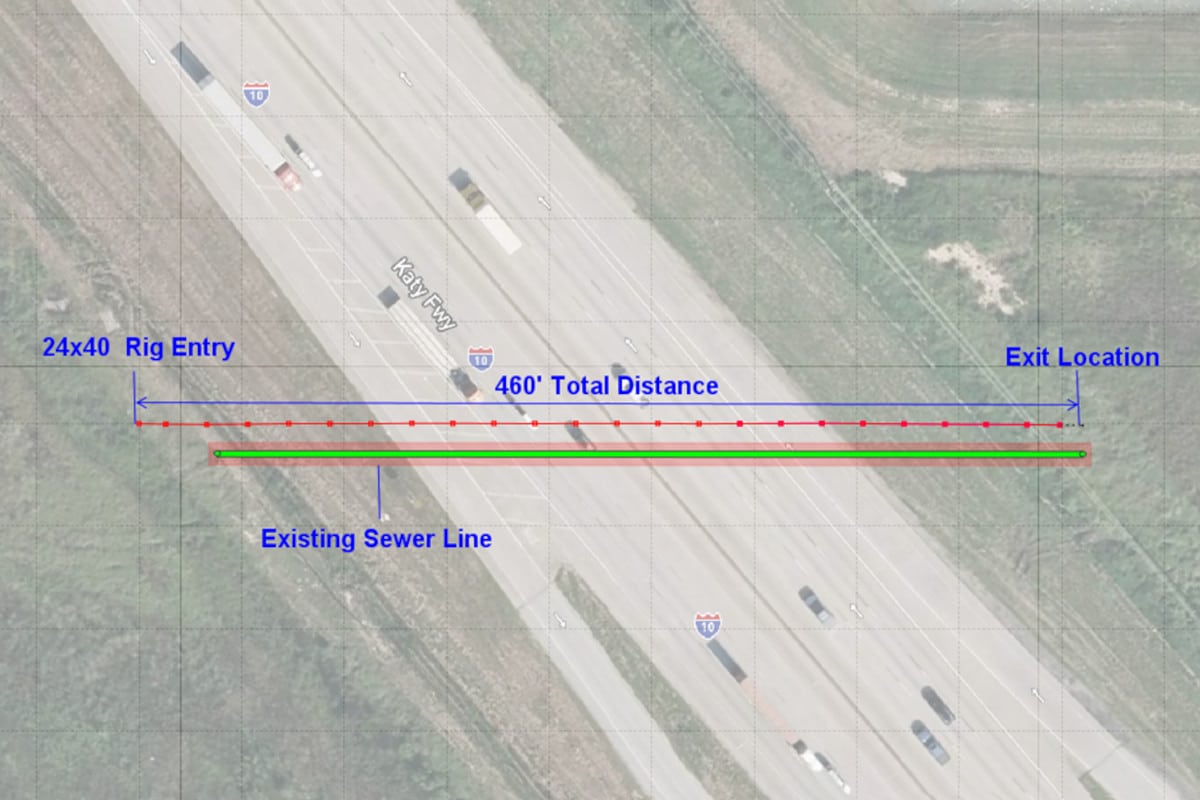
Gyroscopic navigation systems determine tool orientation relative to true north and gravity using inertial sensors. Because they do not rely on surface access or external magnetic references, they are well suited for road crossings, river crossings, railroad bores, and deep urban installations. For example, railroad crossings that would otherwise require personnel to walk active tracks can be completed without anyone entering the railroad right-of-way. This significantly improves jobsite safety.
Similarly, river crossings that exceed walkover depth limits can be planned and executed with confidence using gyroscopic guidance. In this way, crews no longer need to rely on assumptions that may only become problematic once drilling is underway.
Planning for Accuracy and Safety
When gyroscopic guidance is specified upfront, it becomes part of the overall engineering and safety strategy rather than an emergency solution. Bore profiles can be designed with greater confidence. Furthermore, steering decisions are informed by stable, repeatable measurements from the start of drilling.
This approach reduces the likelihood of late-stage corrective steering, which may be difficult or impossible depending on geology and depth. It also minimizes reliance on operator interpretation to compensate for uncertain data. In congested utility corridors, this level of confidence is particularly important for avoiding conflicts with existing infrastructure.
Early gyro planning also eliminates the need for mid-project mobilization of specialized equipment. This improves schedule reliability and allows construction teams to maintain momentum throughout the installation.
Advances in Modern Gyroscopic Systems
Historically, one barrier to early gyro adoption was system size and operational complexity. Early gyroscopic tools were often large, required extended stationary survey periods, and were typically reserved for large rigs and high-profile crossings.
Modern gyroscopic systems have evolved significantly. Advances in sensor miniaturization and processing capability have produced compact tools, such as Sharewell HDD’s Opti-Trac Navigation System, that can be deployed on mid-size and smaller HDD rigs. Shorter tool assemblies and drill collar diameters as small as 3.5 in. allow integration without significantly increasing downhole length or complicating steering.
Practical Implications for Contractors and Owners
For contractors, early use of gyroscopic guidance expands the range of projects that can be executed safely and accurately. Smaller rigs equipped with gyro navigation can complete road, river, and railroad crossings that would otherwise present safety or accuracy challenges using surface-based guidance alone.
For owners and engineers, specifying gyroscopic guidance upfront provides greater certainty in bore execution and documentation. In many cases, the upfront cost is offset by reduced risk, fewer delays, and improved overall efficiency. When viewed as part of the planning process rather than a specialty add-on, gyroscopic guidance becomes a practical and valuable tool.
Conclusion
Gyroscopic guidance systems should no longer be viewed solely as backup solutions when walkover navigation reaches its limits. Advances in gyro navigation technology have made these systems more compact, versatile, and accessible for a wide range of HDD applications.
By considering gyroscopic guidance during the planning phase for road crossings, river crossings, railroad bores, and congested utility corridors, owners and engineers can improve safety, reduce execution risk, and deliver complex installations with greater confidence.
Reid Caspary is technology development manager at Sharewell HDD.
Latest Posts
- Why Gyroscopic Guidance Should Be Considered During HDD Planning

- ERT, CCTV and AI Redefine Leak Detection in Pressurized Water Mains
- Don’t Miss the UESI Pipelines 2026 Conference in Detroit
- UV CIPP Scales Up for Large-Diameter Culverts
- Learn how a Vermeer 24×40 HDD helped a contractor grow


Next Up
2026 Microtunneling Short Course | May 5-7, 2026 | Scottsdale, Arizona | Learn more