HDD Proves Vital to New Mount Holy Pump Station
Horizontal directional drilling (HDD) served a pivotal role in an ongoing $650 million project. This project includes construction of a new pump station for Charlotte Water’s regional wastewater collection and treatment network.
The Mount Holly Pump Station next to Tuckaseege Park, North Carolina, celebrated the opening of the new pump station in September 2025. Wastewater now flows through newly installed lines that connect the community of Mount Holly to Charlotte Water’s system.
“This is a proud moment for Charlotte Water and the City of Mount Holly,” said Charlotte Water director Angela Charles. “The Stowe project shows what’s possible when communities come together with a shared vision. By working across city and county lines, we are building infrastructure that not only serves our residents more efficiently but also safeguards the Catawba River and prepares our region for the future.”
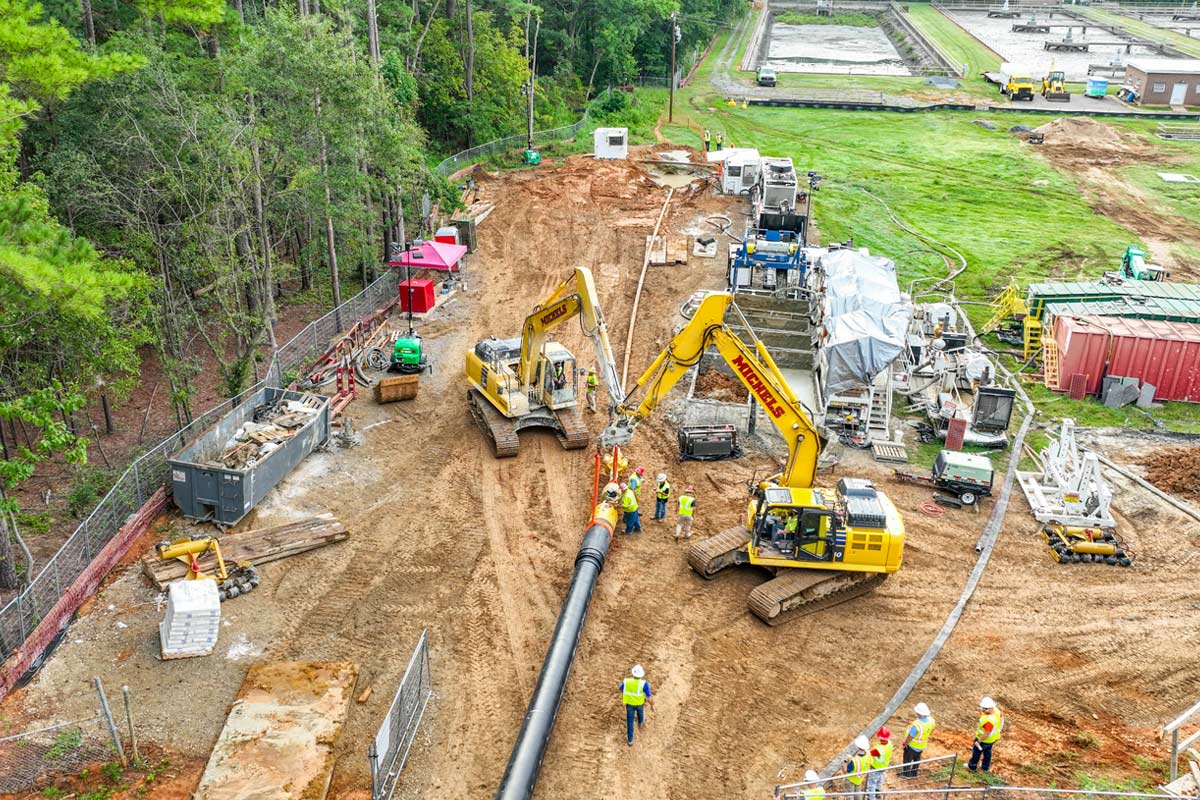
The new Mount Holly Pump Station, which replaces the former Mount Holly Wastewater Treatment Plant on the same site beside Tuckaseege Park, will send approximately 2 to 3 million gallons of wastewater per day through the pipelines. These pipelines are installed 65 to 75 ft beneath the Catawba River and Long Creek. Using HDD, crews from Michels Trenchless, Inc. — which served as the subcontractor for this portion of the project — drilled through bedrock to install the force main lines.
A Critical Upgrade
The new Mount Holly Pump Station will send the wastewater to Charlotte Water’s Long Creek Pump Station daily. After that, it is conveyed to the future Stowe Regional Water Resource Recovery Facility (RWRRF), sometime in 2027. The Stowe RWRRF project — which is about 75 percent complete — will replace two outdated treatment plants in Belmont and Mount Holly. The new facility will be modern and energy-efficient.
Nicole Barlett, engineering capital improvements manager for Charlotte Water, oversees the Stowe RWRRF project. She says this project has been decades in the making, as the need for a new water resource recovery facility in western Mecklenburg County mounted. Agreements with Mount Holly and Belmont were signed in the early 2010s. The Mount Holly portion of the design-build project is ahead of schedule vs. Belmont.
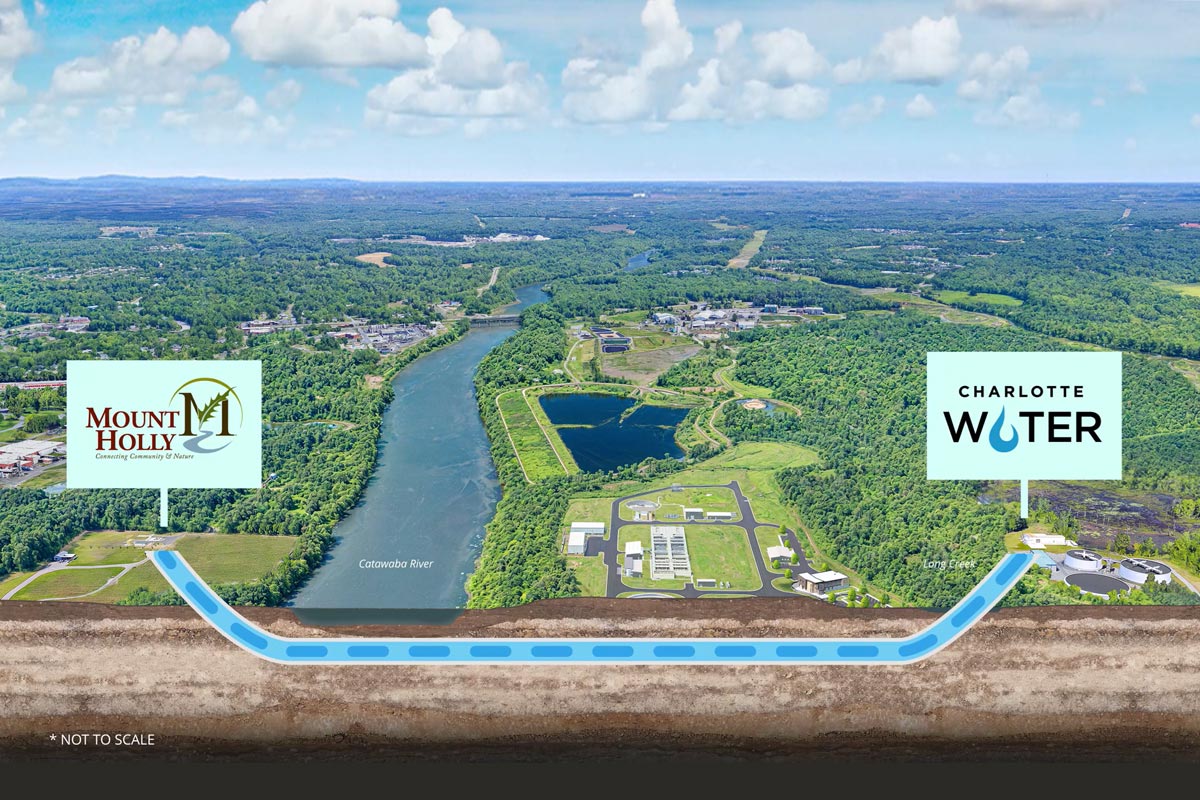
“HDD has allowed for that critical connection between Charlotte Water and Mount Holly, between the Catawba River and Long Creek,” she says. “You can’t shut down a river. HDD was the only realistic option.”
Mount Holly is located across the Catawba River from Mecklenburg County. It is the second-largest municipality in Gaston County and the 20th-largest town or city in the Charlotte Metropolitan area. For more than 100 years, Charlotte Water has been the largest water and wastewater service provider in the Carolinas. Operated by the City of Charlotte, the utility treats more than 106 million gallons of water daily. This serves approximately 1 million residents and visitors from Davidson to Pineville. Charlotte Water maintains more than 8,600 miles of pipes.
HDD Success
The Michels team was brought on to the project during the design-build phase in November 2021, with Jwala Sharma, serving as its project manager. Michels was subcontracted by Haskell, which is the design-build contractor. The construction phase of the HDDs started in April 2022.
Michels completed a set of two parallel drills. The first one involved two 26-in. bores covering 3,020 ft under the Catawba River, with crews using the intersect method. Michels used two of its 880,00-lb rigs. The second crossing involved a 42-in., 1,140-ft crossing under Long Creek. Michels completed the HDD crossings in March 2023.
“The overall project is being done in multiple phases, and our part was initiated in its early phases,” Sharma explained.
Challenging Work
Sharma and Bartlett noted several challenges for the HDD work, most notably the second crossing which involved a tight workspace to layout and fuse the pipe. “Handling the 42-in. pipe in a curved alignment was a bit of a challenge,” Sharma said. “On the exit side, [Charlotte Water] had to drain a pond [to make room] for the pipe.”
Barlett noted the pipe space restrictions, as well. “We did not have a good place to layout the HDPE pipe,” she said, noting the area had wetlands and private property. We ended up fusing two 1,550-ft lengths side by side. [Michels] pulled one and fused the two ends together and then pulled the rest.”
Sharma and Barlett also cited the challenging ground conditions, which included 40,000 psi sandstone. “The first crossing was pretty standard, except that the rock was harder to drill through than initially anticipated,” he said. “The [geology] caused soil interference, taking longer to complete and wearing out our tooling faster.”
Sharma also explained that additional planning was needed for the drilling fluid cuttings for the Long Creek crossing, which involved Brownfields property. “We could not dispose [the cuttings] off site,” he said. “We had to hold the cuttings at the jobsite for an extended period. We solidified the drilling fluid and the cuttings, storing them at the jobsite, before being allowed to remove and dispose of them in a different area on the same Brownfields property, as required by the Emergency Management Plan.
Milestone Project
Barlett said the Stowe RWRRF represents a milestone for Charlotte Water and the communities involved. Upon completion, Stowe RWRRF will treat wastewater from Mount Holly, Belmont and northwestern Mecklenburg County at one location using advanced technology that supports high water quality standards, reduces the number of discharge points into the Catawba River and enhances the region’s environmental sustainability. In direct response to the Greater Charlotte region’s rapid growth, Stowe RWRRF will treat 15 million gallons of wastewater a day initially, with the capacity to expand treating 25 million gallons daily.
Barlett notes that although the HDD work may seem routine to those involved in the HDD industry and who use this technology every day, this project proved to game-changing for Charlotte Water and the surrounding communities. “We’ve been in discussions [for this project] for so long and to finally have this portion in operation is pretty exciting.”
Sharon M. Bueno is editor of Trenchless Technology.
Latest Posts
- HDD Proves Vital to New Mount Holy Pump Station

- Suggested Daily Maintenance Checklist for HDD Mud Reclaimers
- Macomb County Uses Spiral Wound PVC to Renew 15-Mile Interceptor
- Trenchless Technology Canada Roundtable 2026
- City of Newark Goes Trenchless to Repair Historic Pequannock Aqueducts
Next Up
2026 Microtunneling Short Course | May 5-7, 2026 | Scottsdale, Arizona | Learn more