AEM Inducts 2025 Hall of Fame
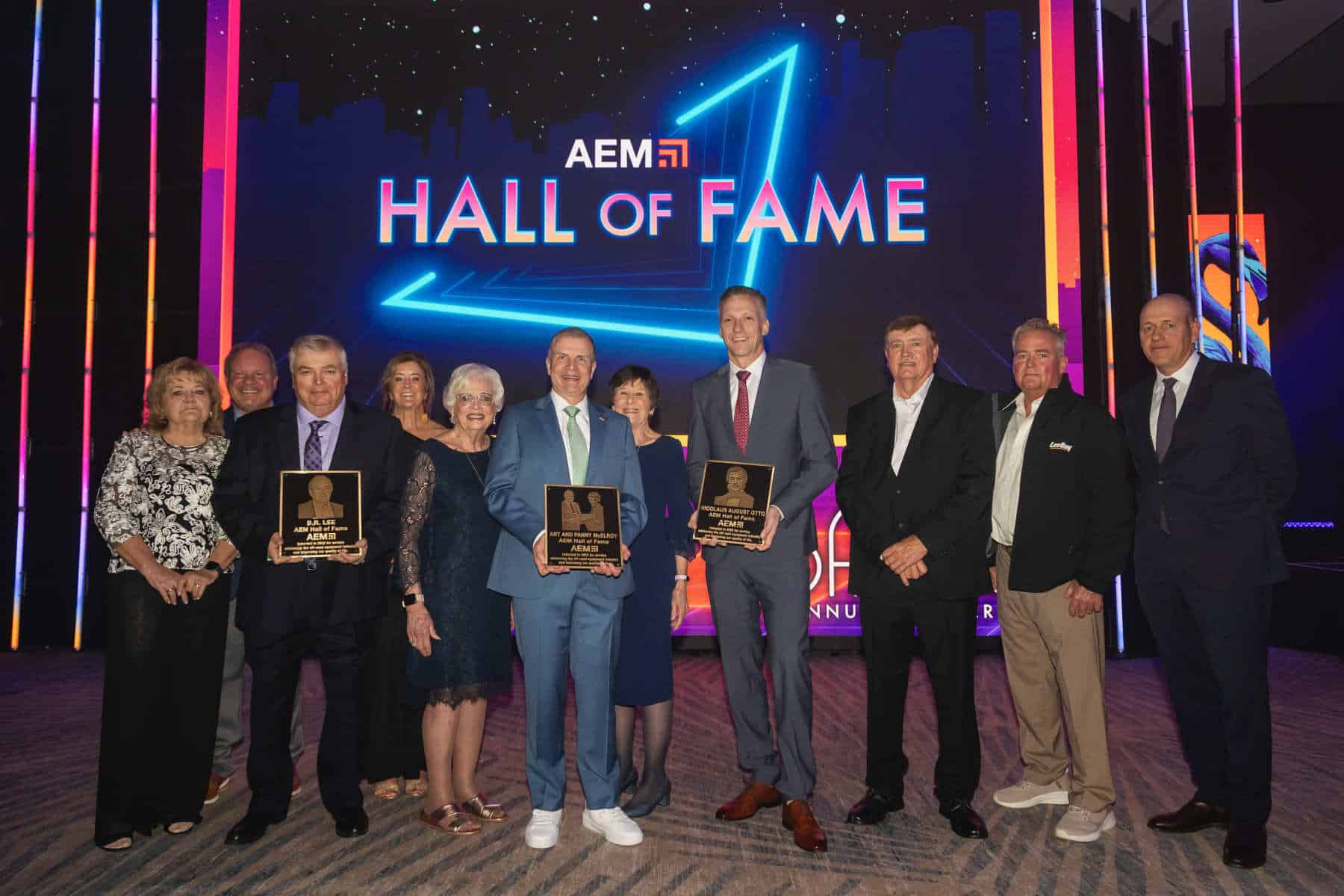
At the finale reception of the Association of Equipment Manufacturers (AEM) Annual Conference in Miami, Florida, the AEM Hall of Fame welcomed three innovative leaders into its ranks.
The AEM Hall of Fame officially inducted Billy Robert “B.R.” Lee, founder of LeeBoy. Art and Panny McElroy, founders of McElroy Mfg., were also inducted. Nicolaus August Otto, engineer and inventor with Deutz, was honored as well. All three inductees were honored posthumously.
“B.R. Lee, Art and Panny McElroy, and Nicolaus August Otto each embody the spirit of innovation and dedication that drives our industry forward,” said AEM President & CEO Megan Tanel. “Their creations undoubtedly transformed the equipment manufacturing industry and inspired future generations. AEM is honored to add them to our Hall of Fame.”
Billy Robert “B.R.” Lee, Founder, LeeBoy
Billy Robert “B.R.” Lee revolutionized the commercial paving industry through innovation, leadership, and unwavering dedication to the paving professional. In the 1960s, he began crafting affordable pull-boxes from scrap metal in his backyard garage. This addressed the needs of small contractors. In 1970, B.R. spawned an entirely new industry with his invention of the first self-propelled commercial-class paver. It was gas-powered with variable widths and intuitive controls. This invention transformed productivity and accessibility. This breakthrough marked the genesis of the LeeBoy brand.
Lee’s commitment to customer feedback drove continuous innovation, including heated screed extensions and the industry-standard 8-foot paver. He also developed specialized equipment like the Force Feed Loader and Maintainer for the North Carolina Department of Transportation. Furthermore, he pioneered features now standard across the industry.
Beyond engineering, Lee built a culture centered on customer satisfaction. Every employee was responsible for ensuring equipment met user needs, no matter their role. His leadership was rooted in humility, integrity, and family values. Employees and dealers alike were treated as extended family, with relationships often sealed by a handshake. Lee’s social responsibility was equally profound. He quietly supported employees and community members in need.
At his core, B.R. was a simple, yet brilliant, farm man who worked hard sun-up to sun-down. He had a habit of doing the right thing, simply because it was the right thing to do. LeeBoy’s success as a company today is a direct result, 61 years later, of B.R.’s ability to successfully imprint his multi-generation farm values on the corporate culture.
Art and Panny McElroy, Founders, McElroy Mfg.
In 1954, Art and Panny McElroy launched McElroy Mfg. from their Tulsa, Oklahoma garage as a fabrication shop for local companies like American Airlines, WL Walker, and Allied Bearing.
With Panny handling the books and Art at the helm, the company flourished. They took on more contract work and expanded their facilities. By the late 1960s, McElroy was shipping its fintube machines around the globe. Yet, the company’s potential wouldn’t be fully realized until 1969. At that time, Art designed a machine that could weld a newly-introduced high-density polyethylene plastic pipe. By 1973, with his passion and focus on the potential of the fledgling polyethylene pipe market, McElroy had built the most complete range of equipment globally. It was capable of fusing from ½” to 48” pipe. In the years that followed, his inventive mind combined with his engineering and manufacturing expertise led to many further advances. These improvements shaped this industry into what it is today.
Art and Panny established a reputation not only for their quality products, but also for their ability to make customers feel welcomed and valued. It wasn’t uncommon for business meetings to turn into “family dinners.” These laid the foundation for long-lasting friendships between the McElroys and their customers. Many of these last to this day.
Art and Panny were instrumental in laying the foundation for many of the company’s most successful ventures, including McElroy University and McElroy’s commitment to supporting its products globally. They also established the network of channel partners that are critical to selling, supporting, and servicing McElroy’s many machine lines. The couple held themselves to a high standard and committed to leading by example in terms of customer service, machine quality, or just making others feel genuinely welcome.
After Art passed away in 1988, Panny took the company’s reins, continuing the vision she and her husband had worked to realize. Almost a decade later, Panny decided it was time to retire as President and CEO of McElroy. She passed the title along to the couple’s son, Chip McElroy. Their daughters, Donna (McElroy) Dutton and Peggy (McElroy) Tanner, serve as the company’s Executive Vice President of Finance and Executive Vice President of Sales for Emerging Markets, respectively.
To this day, the plastic pipe fusion industry owes much of its success to the tireless work of Art and Panny McElroy. Through their commitment to quality, the company continues to reach new heights with each passing year.
Nicolaus August Otto, Engineer & Inventor, DEUTZ
Nicolaus August Otto transformed the world through his groundbreaking work in internal combustion technology. Originally a merchant and traveling salesman, Otto’s fascination with engines led him to experiment with combustion systems. It was a time when the field was still in its infancy. In 1862, he began developing his own four-stroke engine. Just two years later, he co-founded N. A. Otto & Company in Cologne with Eugen Langen. It was the world’s first factory dedicated solely to internal combustion engines and the forerunner of today’s DEUTZ AG.
Their atmospheric gas engine won a gold medal at the 1867 World Exhibition in Paris for its efficiency. However, Otto’s most enduring contribution came in 1876. At this time, he invented the four-stroke engine, a design that became the foundation for modern internal combustion engines.
Otto didn’t stop there. He further enhanced engine independence with the development of magnetic low-voltage ignition. This was a prerequisite for making an internal combustion engine independent of the mains gas supply. His innovations helped mechanize small trades, boost industrial growth, and democratize access to mechanical power. Adaptable to various fuels and applications, it revolutionized how power was generated and used. Otto’s leadership turned complex engineering into practical solutions. His vision earned him global recognition, including an honorary doctorate in 1882 alongside Alexander Graham Bell. His legacy lives on in every car, truck, and industrial engine today. This is proof that one man’s curiosity and persistence can reshape the world.
About the Hall of Fame
The AEM Hall of Fame has been recognizing luminaries in the agriculture and construction equipment manufacturing industry since 1993, and includes such names as Benjamin Holt (Caterpillar), Joseph Cyril Bamford (JCB), Jerome Increase Case (CNH Industrial), John Deere (Deere & Co.), Gus Ramirez (HUSCO International) and Mary Andringa (Vermeer). The induction of Lee, the McElroys, and Otto brings the total number of inductees to 74.
The Association of Equipment Manufacturers (AEM) Hall of Fame recognizes the pioneers whose inventions, ideas, leadership and courage have built, fed, and powered our modern world.