A Threat to Culvert Rehabilitation
Imagine the chaos that would result from eliminating culvert sliplining options. Imagine also replacing every failing culvert with a bridge span design. The disruption to the traveling public caused by detours would be unimaginable. Moreover, Emergency Vehicle delays would be life threatening.
Yet this design concept is catching on outside of the environmentally sensitive areas where it is necessary. As a result, it is being used as an impractical catch all measure of slothful culvert design.
Optimization Among Alternatives
Environmental regulatory agencies that require a visual observation of bank full width to size culverts by matching the culvert size to the width of the upstream banks may be failing when using this methodology across the board of culvert design. Bankfull width designs may be relevant in environmentally sensitive streams. However, applying this rudimentary method universally to all culvert designs is not practical. In most cases, it would eliminate the consideration of the rehabilitation of culverts using trenchless technology culvert rehabilitation systems.
From a hydraulic design engineer’s perspective, the initial step for determining the size of a culvert involves conducting a hydrologic study of the watershed contributing to the culvert. Since hydrology is the study of water, encompassing its properties, distribution, and movement across Earth’s surface, this complex system considers numerous factors such as land use, slope, rainfall data, ground saturation, and storage within the system. Engineers utilize this data through several programs and models to determine different runoff discharge totals during specific events. These events include particular focus on the 50 and 100-year storms. After calculating stormwater runoff totals, engineers proceed to analyze the hydraulics of the system.
Hydraulics is the study of the conveyance of liquids (in this case water) through pipes and channels, especially as a source of mechanical force or control. Hydraulic analysis of culverts includes factors such topography, land use, size, shape, slope, friction, losses, and historical data, which are considered to model the hydraulic system. Through an iterative process, the engineer selects a culvert design. The design can handle the runoff discharge determined in the hydrologic study. This also includes trenchless technologies that drastically reduce costs. Such technologies have limited impact on the traveling public.
Real World Example
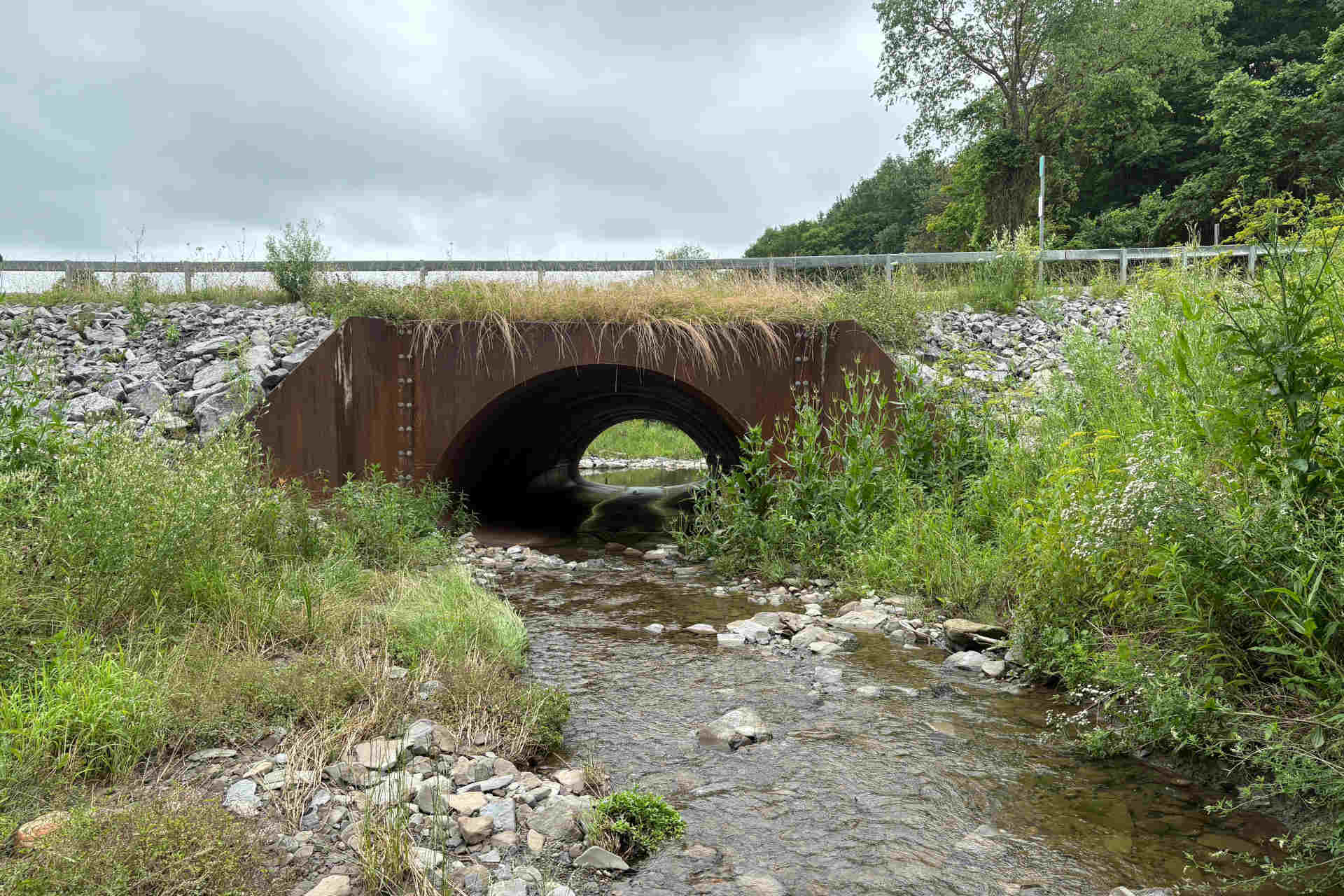
A real-world example illustrates the limitations of using “bankfull width” for sizing culverts. In this example, an engineer has determined that an 18-ft span culvert is required based on extensive studies, adhering to engineering standards, to accommodate both the 50 and 100-year storm events at an estimated cost of $900,000.
Simultaneously, an environmentalist conducts a field visit and determines the “bankfull width” to be approximately 32 ft, exceeding the 20-ft limit for a culvert, necessitating the need for the structure to be designed as a bridge instead. The revised construction cost for a bridge of this width is approximately $4 million. This figure is over four times the cost of constructing the proposed 18-ft culvert. This estimate excludes life cycle costs.
Ironically, constructing the larger bridge will also have a greater overall footprint, with the potential for other environmental impacts. This is all being concluded without consideration of the next upstream culvert which has a span of 13 ft, significantly smaller than the proposed bridge. Its cross-sectional area could easily be matched with a slip lining product inside of the 18-ft span failing culvert.
As a result, the cost to build such a large culvert or bridge will increase exponentially. Not only is this expenditure realized in constructing a larger structure, but also in design, where countless hours are spent defending why using “bankfull width” is inappropriate. Beyond this, future costs are realized while maintaining a larger culvert or even a bridge. This will also require a completely new set of design standards. There is potential for property acquisitions, which will delay the project and jeopardize the failing culvert.
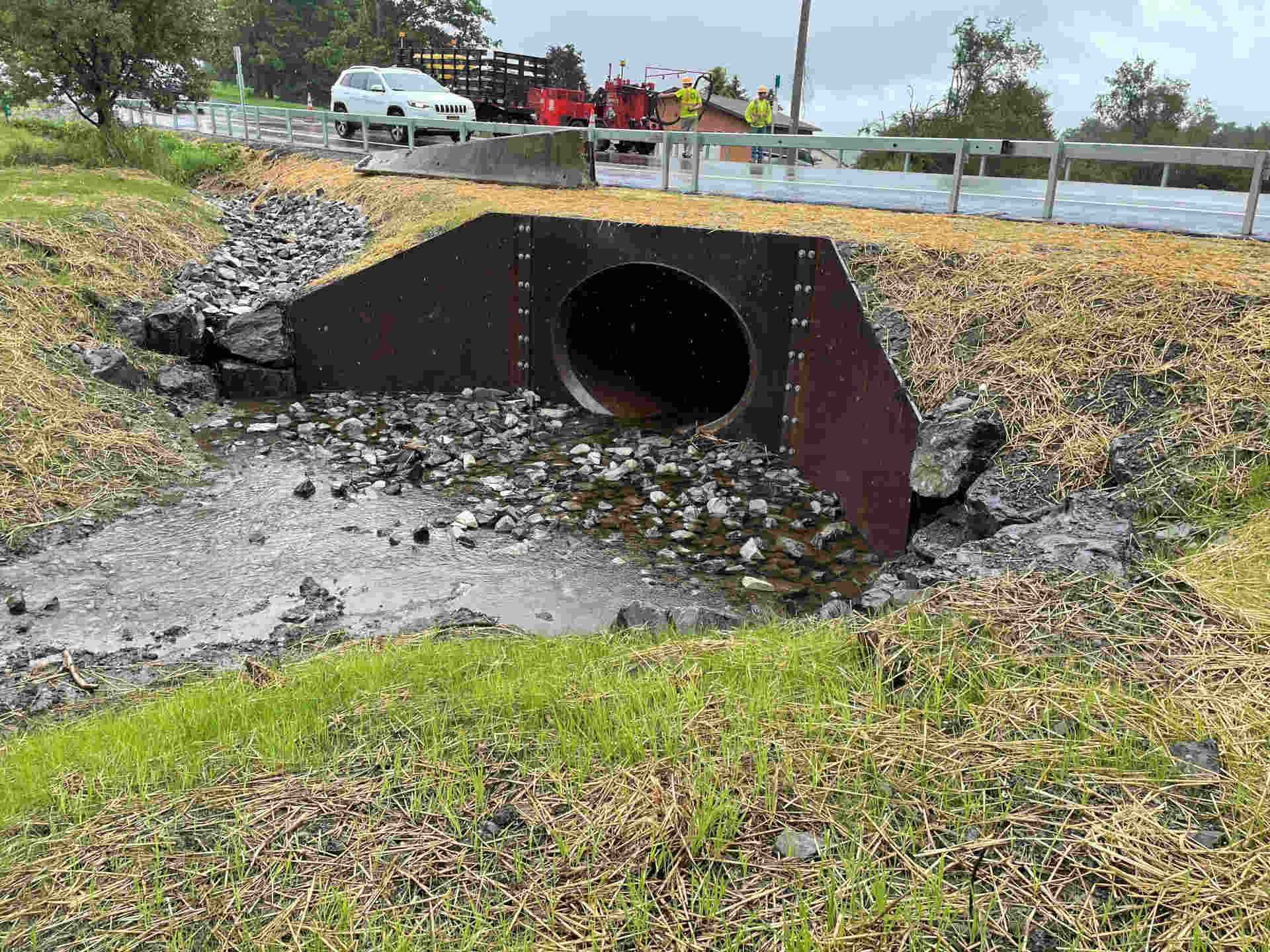
At this point, one can easily see why we should start questioning the motives behind universally accepting “bankfull width” as the determining factor for sizing a culvert.
Ordinary High Water
In addition, we need to look at another requirement dictated by the environmental agencies, and arguably the one they are most concerned with, Ordinary High Water. This is defined by the regulating agency as “generally” equivalent to the width of the channel during the two-year design storm.
So, the question becomes, are we concerned with the two-year storm event or the 10,000-year storm event, as dictated by a 32-ft bridge? If the engineer has designed the culvert to convey the 100-year runoff total (per design standards), it can comfortably accommodate the environmental concerns of aquatic movement and connectivity during the two-year event. So, why oversize a culvert to handle a storm event that has historically never occurred?
Determining if a culvert should be rehabilitated or replaced with a bridge or larger culvert should be based on rigorous engineering rather than estimations of bankfull width. There are no calculations nor formulas in determining bankfull width. It is simply defined as “a visual observation of the stream’s mean high-water elevation, usually distinguishable by the edge of dense, terrestrial rooted vegetation and the physical characteristics of an average high-water elevation.” Terms such as visual’, ‘usually’ and ‘average’ are far too subjective. This results in an ever-changing measurement that will oversize the culvert and ignore engineering complexities.
This oversimplification of the design process, based solely on field observations of bankfull width, often leads to increased costs, involves traffic detours, and eliminates the possibility of utilizing most, if not all trenchless technologies. It is essential to use engineering principles and common sense to accurately determine the best alternatives for culverts that have exceeded their design life. Trenchless technologies offer many structural and hydraulic alternatives while minimizing environmental impact. Good culvert design optimizes alternatives.
Cullom Walker is co-founder at InfraSteel and partner at Precision Pipe & Products.
Latest Posts
- A Threat to Culvert Rehabilitation

- United Felts Expands with BKP Berolina Acquisition
- Why Gyroscopic Guidance Should Be Considered During HDD Planning
- ERT, CCTV and AI Redefine Leak Detection in Pressurized Water Mains
- Don’t Miss the UESI Pipelines 2026 Conference in Detroit





Next Up
2026 Microtunneling Short Course | May 5-7, 2026 | Scottsdale, Arizona | Learn more