2025 No-Dig North Project of the Year New Installation
Nose Creek Sanitary Sewer Trunk Project Phase B – Contract 4
As Canada’s third largest city, Calgary is constantly looking at ways to expand capacity. The city also works to improve resiliency of its sewer and water infrastructure.
One of those projects – the Nose Creek Sanitary Sewer Trunk Project (NCSST) – involves twinning the existing sanitary sewer trunk that runs from the Bow River, north beyond Beddington Trail N.E. Phase B – Contract 4 of the NCSST is receiving national attention as the recipient of the 2025 No-Dig North Canadian New Installation Project of the Year. Also, the project shows the industry the ever-increasing capabilities of microtunnelling.
Project Background
The NCSST more than doubles the sanitary sewer capacity. It is required to accommodate future development and population growth in north Calgary.
Based on anticipated growth the Nose Creek sanitary sewer system would have reached capacity by 2030. In 2008, the city began looking at upgrading the sewer. With CH2M (now Jacobs) at the helm, the upgrade took place in three phases.
Phase A involved twinning the existing sanitary sewer trunk along Nose Creek from the Bow River to 32 Ave N.E. Construction. Work began in 2010 and was complete in 2013.
Phase C, the Saddle Ridge Sanitary Sewer Trunk Upgrade, added a relief sanitary sewer trunk connection to the Nose Creek sanitary sewer trunk from Fox Hollow Golf Course, under Deerfoot Trail, and into the sanitary system near 11 St N.E. and 12 St N.E. This system services a large portion of northeast Calgary. This portion was complete in 2017.
Phase B took place in five subcontracts. Contract 4 includes construction of a twinning sewer for approximately 2.3 km. This work consists of reinforced concrete pipe (RCP) with an HDPE liner. Trenchless comprised 1,501 m of Contract 4 along the west bank of Nose Creek. Trenchless installation also comprised another 260 m of 1,500-mm pipe beneath Nose Creek.
Contract Award
Ward & Burke Microtunnelling Ltd. of Mississauga, Ontario was awarded the contract for Phase B – Contract 4 in January 2024.
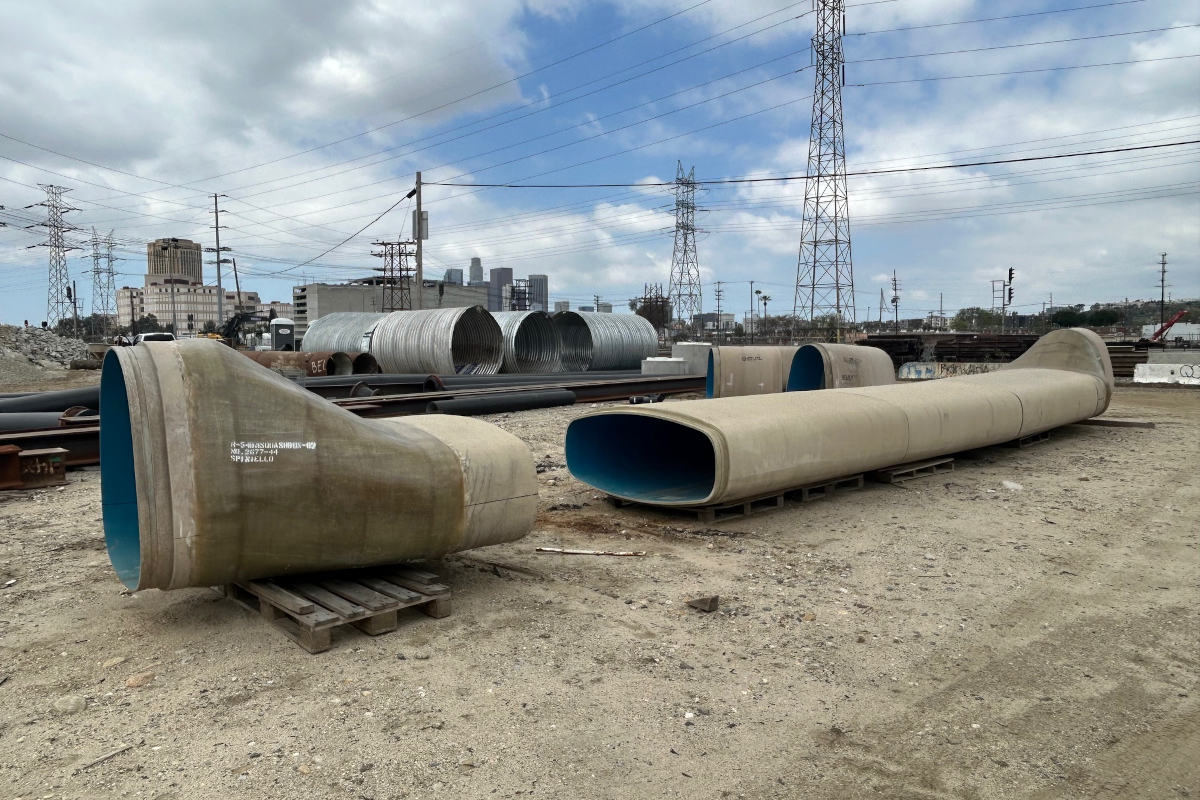
For its part, Ward and Burke was tasked with building three caisson shafts. They installed 1.5 km of 1,650-mm ID HDPE lined reinforced concrete pipe (RCP) via microtunneling. Ward and Burke also installed 255 m of 1,500-mm HDPE lined RCP via microtunnelling. In addition, they installed 500 m of 1,650-mm FRP pipe via the open-cut method. Additionally, they constructed permanent works chambers and one live sewer tie-in.
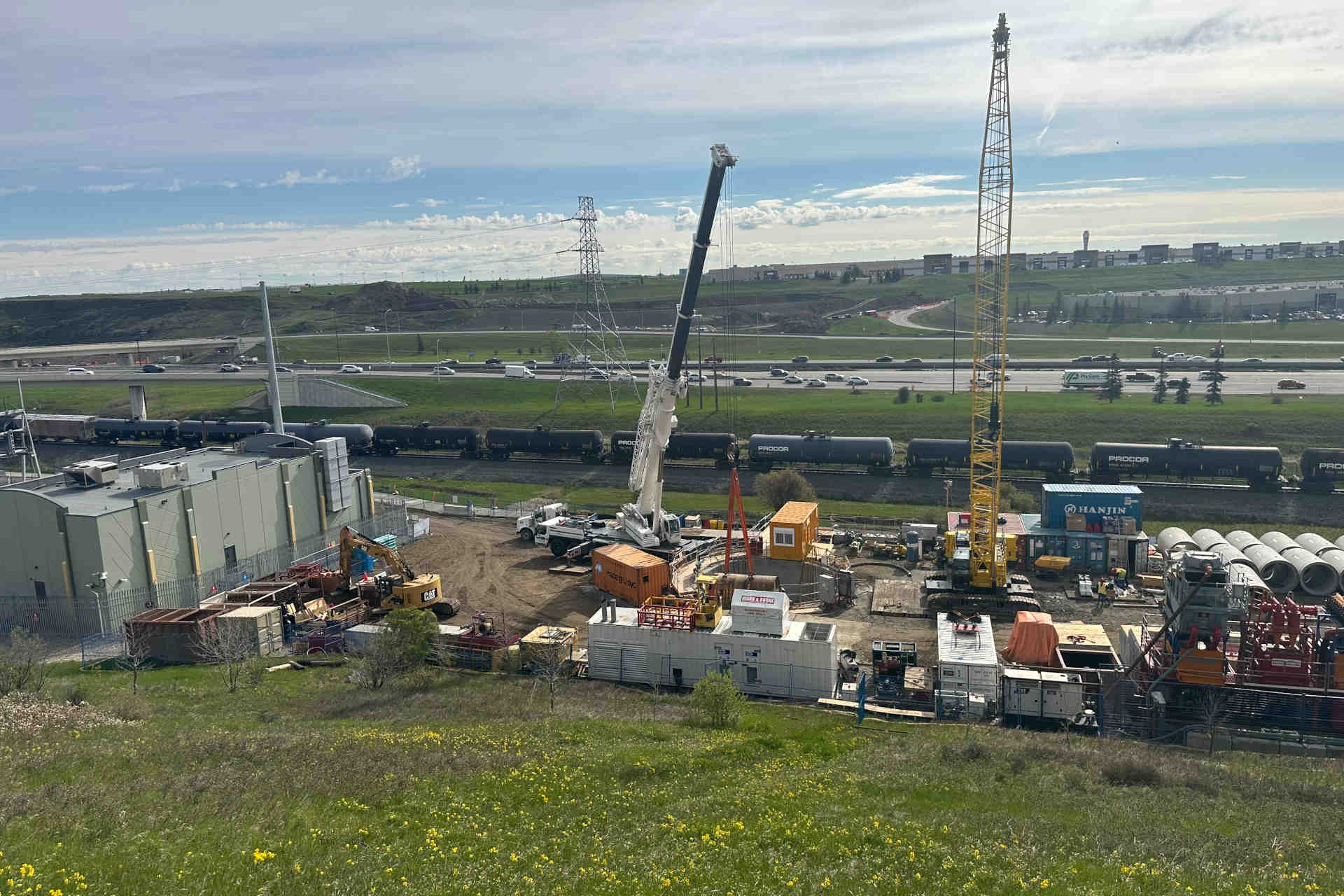
To safely launch and retrieve the Herrenknecht microtunnel boring machine (MTBM), Ward and Burke designed and constructed a 9.2-m ID concrete caisson launch shaft. They built a 6-m ID concrete caisson reception shaft and a 5-m ID concrete caisson reception shaft. The launch shaft was designed with heavily reinforced sections behind the jacking frame. This reinforcement was to resist jacking forces induced during microtunnelling operations. All three shafts were sunk in clay on top of claystone.
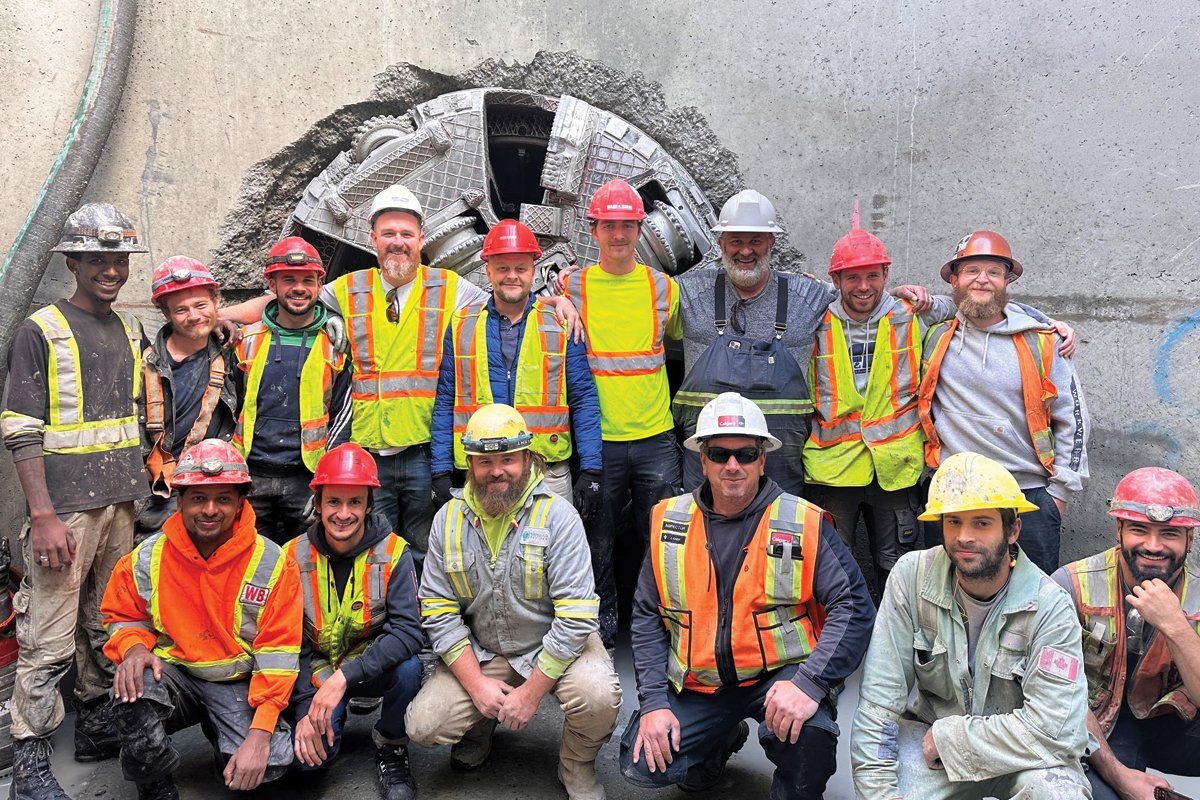
The NCSST project is exceptional in the fact that it broke the record for the longest single microtunnel drive completed to date in North America. Ward and Burke launched the first drive on the project on May 22, 2024. They broke through the reception shaft on Sept. 29, 2024. The single drive was 1.5-km long. It featured four horizontal curves ranging from 700-m to 1.750-m radius.
The 1.5-km tunnel was constructed in ground conditions ranging from stiff clay/weak claystone to 20 MPa Sandstone. The entire alignment was under the water table.
Project Details
PROJECT OWNER: The City of Calgary
ENGINEER: Jacobs
CONTARCTOR: Ward & Burke Microtunnelling Ltd.
SUPPLIERS & MANUFACTURERS: Herrenknecht, Precon Manufacturing
VALUE OF TRENCHLESS PROJECT (US$): $18,521,000
Long Distance Microtunnelling
A Herrenknecht AVN 1500 with an upskin kit was used to construct the 1,650-mm ID HDPE lined RCP tunnel. The mixed face cutting head was fitted to the MTBM.
What’s even more remarkable about this drive is that although three intermediate jacking stations (IJS) were used, none of them needed to be engaged. The full drive was completed from the jacking frame in the launch shaft. It broke through at the reception with only 400 T force on the jacking frame.
This drive further promotes the capabilities of long distance microtunnelling. This success is due to the correct tunnelling equipment, lubrication systems, and pump setups. Most importantly, a competent and experienced crew played a vital role.
The same Herrenknecht AVN1500 base machine was used to construct the 1,500-mm HDPE lined RCP tunnel. The 1,500-mm siphon included two vertical curves. It launched downhill with a vertical curve (Radius = 1,000 m) and then crossed under a CPKC line and Nose Creek. After that, it curved back up with a radius of 720 m to reach the reception.

Why Project Is Outstanding
The NCSST project is exceptional in the fact that it broke the record for the longest single microtunnel drive completed to date in North America. The single drive was 1.5km long. It featured four horizontal curves ranging from 700-m to 1,750-m radius.
The 1.5-km tunnel was constructed in ground conditions ranging from stiff clay/weak claystone to 20 MPa Sandstone. The entire alignment was under the water table.
What’s even more remarkable about this drive is that although three intermediate jacking stations were used, none of them needed to be engaged. The full drive was completed from the jacking frame in the launch shaft. It broke through at the reception with only 400 T force on the jacking frame (22 percent capacity of the frame).
This drive further promotes the capabilities of long distance microtunnelling with the correct tunneling equipment, lubrication systems, pump setups, etc. Most importantly, success depends on a competent and experienced crew.
This story was compiled by Trenchless Technology Canada staff using information provided by Ward & Burke Microtunnelling Ltd.
Latest Posts
- How Is the Trenchless Rehab Market Faring in Today’s Economic Climate?

- NASTT-BC Hosts Trenchless Fundamentals in the North Event
- NASTT No-Dig Show 2026 Preview
- NASSCO Report – The Key to Long-Lasting Sewer Structure Rehab: Think Holistically
- IQuip Introduces the BOOST HDD Support Truck




Next Up
2026 Microtunneling Short Course | May 5-7, 2026 | Scottsdale, Arizona | Learn more